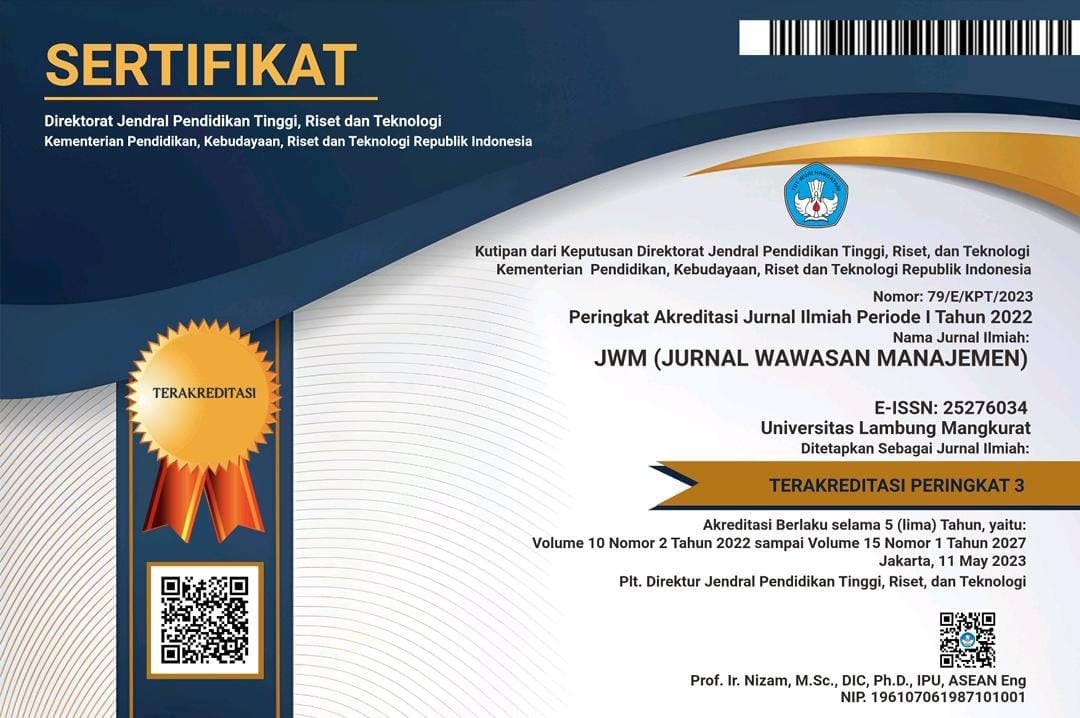
TAX PLANNING DAN NILAI PERUSAHAAN (STUDI PADA PERUSAHAAN PERTAMBANGAN DI BEI TAHUN 2016-2018)
DOI:
https://doi.org/10.20527/jwmthemanagementinsightjournal.v10i3.217Keywords:
tax planning, firm valueAbstract
Aggressive tax planning has an impact on reducing the amount of taxes that must be paid to the state. Several mining companies in Indonesia are indicated to carry out aggressive tax planning. By using signal theory, companies that carry out tax planning can have an impact on decreasing the value of the company because the company is indicated to have violated tax regulations. This study will examine whether the tax planning by the company has a negative effect on the company. The research design used is quantitative research using hypotheses. The hypothesis proposed is that tax planning has a negative effect on firm value. Hypothesis testing using multiple linear regression. The research sample used is a mining company that went public on the Indonesia Stock Exchange (IDX) in 2016 – 2018. The independent variable is tax planning while the dependent variable is company value, this study also uses control variables, namely profitability and leverage. Measurement of tax planning by using the effective tax rate (ETR) and ETR differential, while the value of the company is measured by using the price to earnings ratio (PER). Profitability control variable is measured using return on assets (ROA) and leverage is measured using debt to equity ratio (DER). The results show that the smaller the ETR, the smaller the PER of the company. The larger the ETR differential, the smaller the PER of the company. The smaller the ETR or the larger the ETR differential indicates that the more aggressive the tax planning is carried out by the company and the greater the tax planning will have an impact on decreasing the value of the company so that the hypothesis in this study is accepted. The conclusion of this study is that tax planning that is carried out aggressively by the company can potentially violate tax regulations applied by a country so that this policy can affect the value of the company to be down.Keywords: tax planning, firm value
Downloads
References
Brigham dan Houston, 2010. Dasar-dasar Manajemen Keuangan Buku 1 (Edisi 11), Jakarta: Salemba Empat
Desai, M. A., & Dharmapala, D. (2009). Corporate tax avoidance and firm value. The Review of Economics and Statistics, 91(3), 537-546. http://dx.doi.org/10.1162/rest.91. 3.537
Dewanata, P dan Achmad, T. (2017). Pengaruh Perencanaan Pajak terhadap Nilai Perusahaan dengan Kualitas Coorporate Governance sebagai Variabel Moderasi (Studi Empiris pada Perusahaan Manufaktur yang terdaftar di BEI pada tahun 2012 – 2014). Diponegoro Journal Of Accounting Vol. 6 No.1. ISSN(Online): 2337-3806. http://ejournal-s1.undip.ac.id/index. php/accounting
Dyreng, S. D., Hanlon, M., & Maydew, E. L. (2008). Long-run corporate tax avoidance. The Accounting Review, 83, 61-82. http://dx.doi.org/10.2308/accr.2008.83.1.61
Fadilah, N dan Wijayanti, P. (2017). Book Tax Diferrences dan Persistensi Laba pada Perusahaan Manufaktur. Jurnal Akuntansi Multiparadigma Vol. 8 No.2. pISSN 2086-7603
Ftouthi, K.; Ayed, A. dan Zemzem, A. (2015). Tax Planning and Firm Value: Evidence from European Companies. International Journal Economics and Strategic Management of Business Process. Vol. 4, pp: 73-78.
Graham, J.R.; Hanlon, M; Shevlin, T; and Shroff, N. 2014. “Incentives for Tax Planning and Avoidance: Evidence from the Field”. The Accaounting Review, Vol 18, No. 3, pp: 99-1023, https://doi.org/10.1016/j.jacceco.2018.01.001
Hanlon, M. and Heitzman, S., 2010. A review of tax research. Journal of Accounting and Economics 50, 127–178.
Herawati, H dan Ekawati, D. (2016). Pengaruh Perencanaan Pajak terhadap Nilai Perusahaan. Jurnal Riset Akuntansi Keuangan, Vol 4, No. 1. SSN:2541-061X (Online). ISSN:2338-1507(Print). http://ejournal.upi.edu/index.php/JRAK
Ilaboya, O.J; Izevbekhaei, M.O. and Ohioka, F.I. (2016). Tax Planning and Firm Value: A Review Literatur. Business and Management Research Vol 5, No. 2. http://bmr.sciedupress.com
Lestari, Nanik. (2014). Pengaruh Tax Planning terhadap Nilai Perusahaan. Akuntabilitas Vol. VII No.1, pp: 69 – 83. P.ISSN: 1979-858X
Mgammal, M.H. Coorporate Tax Planning and Corporate Tax Disclosure. Meditary Accountancy Research. 2049-372X. DOI10.1108/MEDAR-11-2018-0390
Minnick, & Noga, T. (2010). Do corporate governance characteristic influence tax management. Journal of Corporate Finance, 16, 703-718. http://dx.doi.org/10.1016/ j.jcorpfin.2010.08.005
Pohan, Chairil Anwar. (2013). Manajemen perpajakan “strategi perencanaan pajak dan bisinis”.Jakarta : PT.Gramedia Pustaka Utama
Pradnyana, I.B.G dan Noviari, N. (2017). Pengaruh Perencanaan Pajak terhadap Nilai Perusahaan dengan Transparasi Perusahaan sebagai Variabel Moderasi. E-Jurnal Akuntansi Universitas Udayana Vol. 18.2. ISSN: 2302-8556.
Richardson, Grant; Wang, Bei; and Zhan, Xinmin. (2016). “Ownership Strucutre and Coorporate Tax Avoidance: Evidence from Publicily Listed Private Firms in China”. Journal of Contemporary Accounting and Economics . http://dx.doi.org/10.1016/j.jcae.2016.06.003
Suandy, Erly. 2011. Perencanaan Pajak. Jakarta: Salemba Empat.
Wahab, N. S., & Holland, K. (2012). Tax planning, corporate governance and equity value. The British Accounting Review, 44, 111-124. http://dx.doi.org/10.1016/j.bar.2012.03.005
Wang, T. X. (2010). Tax avoidance, corporate transparency, and firms value. Retrieved 2013, from http://ssrn.com
Zain, Muhammad. (2008). Manajemen Perpajakan. Edisi 3. Jakarta: Salemba Empat

Downloads
Published
Issue
Section
License
Copyright (c) 2022 JWM (JURNAL WAWASAN MANAJEMEN)

This work is licensed under a Creative Commons Attribution 4.0 International License.