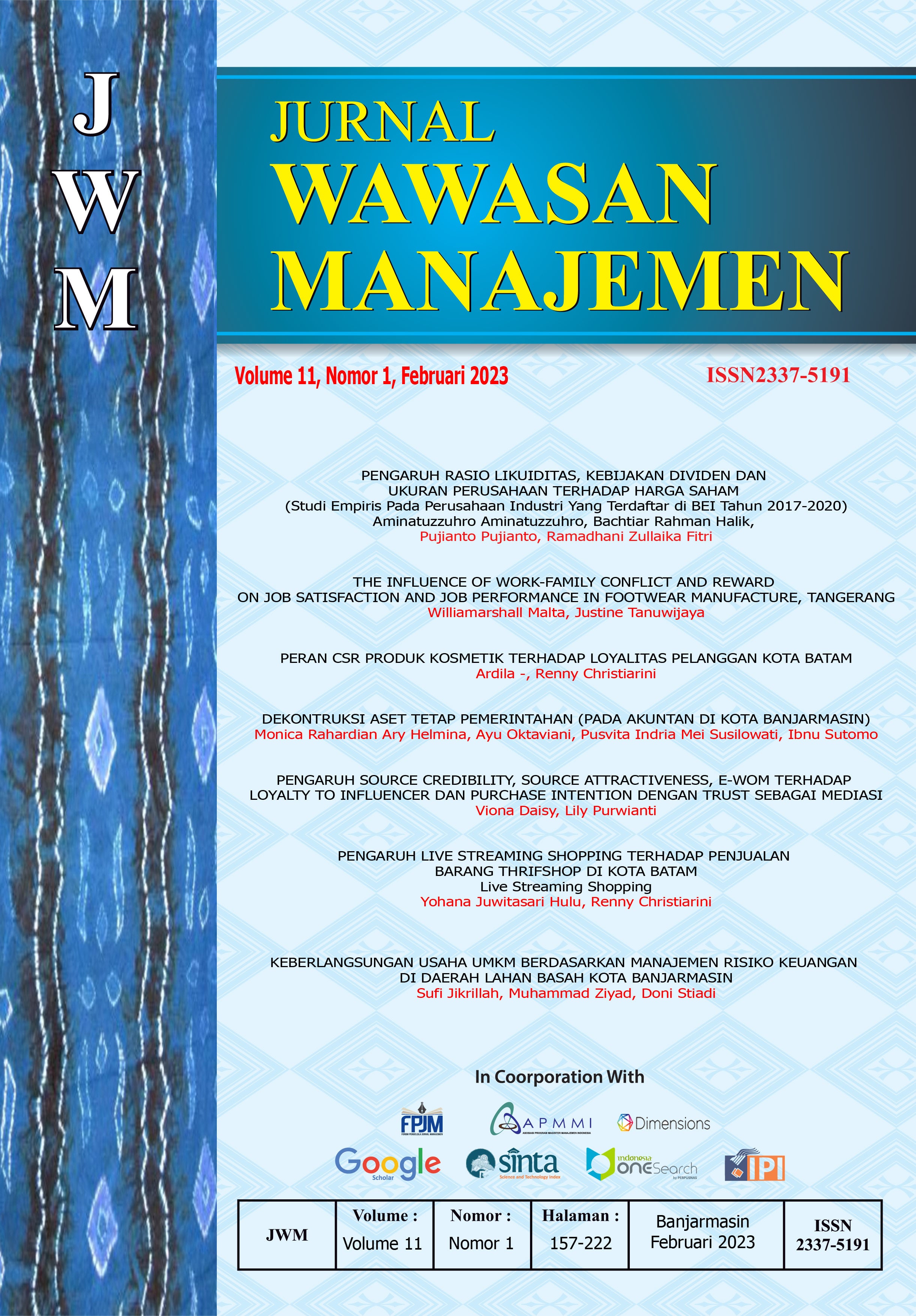
THE INFLUENCE OF WORK-FAMILY CONFLICT AND REWARD ON JOB SATISFACTION AND JOB PERFORMANCE IN FOOTWEAR MANUFACTURE, TANGERANG
DOI:
https://doi.org/10.20527/jwmthemanagementinsightjournal.v11i1.236Keywords:
Family-friendly Policies, Supervisor Support, Work-family Conflict, Reward, Job Satisfaction, Job PerformanceAbstract
This study aims to examine the effect of family-friendly policies and supervisor support on work-family conflict as well as the effect of work-family conflict and rewards on job satisfaction and job performance. This study uses a quantitative approach by using a questionnaire. Questionnaires were given to 93 respondents who are employees of the footwear manufacturing industry in Tangerang, Banten. Data analysis was performed using SEM-PLS. The results showed that there was a significant effect of supervisor support and reward on work-family conflict and job satisfaction as well as the effect of job satisfaction on job performance. The results imply that employee feel more satisfied with their work and increase their performance while conflict between their work and family can be decreased caused support from their leaders.
Downloads
References
Abbas, J., un Nisa Khan, N., Barkat Ali, S., & Kumari, K. (2021). Examining the Role of Motivation and Reward in Employees’ Job Performance through Mediating Effect of Job Satisfaction: An Empirical Evidence INTERNATIONAL JOURNAL OF ORGANIZATIONAL LEADERSHIP. In International Journal of Organizational Leadership (Vol. 10).
Anderson, S. E., Coffey, B. S., & Byerly, R. T. (2002). Formal Organizational Initiatives and Informal Workplace Practices: Links to Work-Family Conflict and Job-Related Outcomes. In Journal of Management (Vol. 28, Issue 6).
Bae, K. bin, & Yang, G. (2017). The Effects of Family-Friendly Policies on Job Satisfaction and Organizational Commitment: A Panel Study Conducted on South Korea. Public Personnel Management, 46(1), 25–40. https://doi.org/10.1177/0091026016689669
Choi, J. H., & Ahn, S. H. (2017). The Relationship among Family-Friendly Policies, Work-Life, Family-Life, and Intention of Childbirth. Journal of Korean Home Management Association, 35(2), 77–92. https://doi.org/10.7466/jkhma.2017.35.2.77
Dhir, S., & Dutta, T. (2020). Linking supervisor-support, person-job fit and person-organization fit to company value. Journal of Indian Business Research, 12(4), 549–561. https://doi.org/10.1108/JIBR-04-2019-0124
Dousin, O., Wei, C. X., Balakrishnan, B. K. P. D., & Lee, M. C. C. (2021). Exploring the mediating role of flexible working hours in the relationship of supervisor support, job and life satisfaction: A study of female nurses in China. Nursing Open, 8(6), 2962–2972. https://doi.org/10.1002/nop2.1008
Freire, C., & Bettencourt, C. (2020). Impact of ethical leadership on job satisfaction: the mediating effect of work–family conflict. Leadership and Organization Development Journal, 41(2), 319–330. https://doi.org/10.1108/LODJ-07-2019-0338
Frye, N. K., & Breaugh, J. A. (2004). FAMILY-FRIENDLY POLICIES, SUPERVISOR SUPPORT, WORKÀFAMILY CONFLICT, FAMILYÀWORK CONFLICT, AND SATISFACTION: A TEST OF A CONCEPTUAL MODEL.
Ghasemy, M., Rosa-Díaz, I. M., & Gaskin, J. E. (2021). The Roles of Supervisory Support and Involvement in Influencing Scientists’ Job Satisfaction to Ensure the Achievement of SDGs in Academic Organizations. SAGE Open, 11(3). https://doi.org/10.1177/21582440211030611
Hair, J. F., Sarstedt, M., & Ringle, C. M. (2019). Rethinking some of the rethinking of partial least squares. European Journal of Marketing, 53(4), 566–584. https://doi.org/10.1108/EJM-10-2018-0665
Hasanudin, A. I., Yuliansyah, Y., Muafi, & Putri Ramadhani, B. (2018). Four possible rewards (or punishments) for innovation - Their effect on the employee. Problems and Perspectives in Management, 16(2), 232–240. https://doi.org/10.21511/ppm.16(2).2018.21
Huy, P. Q., Nhi, V. van, & Lam, P. T. (2019). THE INTERACTION EFFECT OF TASK – TECHNOLOGY FIT AND JOB SATISFACTION ON JOB PERFORMANCE IN ERP CONTEXT: CASE STUDY OF VIETNAMESE ENTERPRISES. Eurasian Journal of Economics and Finance, 7(1), 48–61. https://doi.org/10.15604/ejef.2019.07.01.004
Martinez-Sanchez, A., Perez-Perez, M., Vela-Jimenez, M. J., & Abella-Garces, S. (2018). Job satisfaction and work–family policies through work-family enrichment. Journal of Managerial Psychology, 33(4–5), 386–402. https://doi.org/10.1108/JMP-10-2017-0376
Matagi, L., Baguma, P., & Baluku, M. M. (2022). Age, job involvement and job satisfaction as predictors of job performance among local government employees in Uganda. Journal of Organizational Effectiveness: People and Performance. https://doi.org/10.1108/JOEPP-06-2020-0099
Mosquera, P., Soares, M. E., & Oliveira, D. (2020). Do intrinsic rewards matter for real estate agents? Journal of European Real Estate Research, 13(2), 207–222. https://doi.org/10.1108/JERER-12-2019-0051
Muchiri, H. (2016). EFFECTS OF REWARDS ON EMPLOYEE PERFORMANCE IN THE HOSPITALITY INDUSTRY: A CASE OF NAIROBI SERENA HOTEL.
Nayak, A., & Pandey, M. (2021). A Study on Moderating Role of Family-Friendly Policies in Work–Life Balance. Journal of Family Issues. https://doi.org/10.1177/0192513X211030037
Netemeyer, R. G., Boles, J. S., & Mcmurrian, R. (1996). Development and Validation of Work-Family Conflict and Family-Work Conflict Scales. In Journal of Applied Psychology (Vol. 81, Issue 4).
Otu, S. E., Sun, I., Akor, C. I., Nnam, M. U., Wu, Y., & Aro, G. (2021). Explaining job satisfaction and voluntary assistance among Nigerian police officers. Policing, 44(5), 941–956. https://doi.org/10.1108/PIJPSM-01-2021-0002
Panda, A., Jain, N. K., & Nambudiri, R. (2021). Work–family conflict, affective commitment, leadership and job satisfaction: a moderated mediation analysis. International Journal of Productivity and Performance Management. https://doi.org/10.1108/IJPPM-01-2020-0040
Park, S., Kang, H. S. (Theresa), & Kim, E. J. (2018). The role of supervisor support on employees’ training and job performance: an empirical study. European Journal of Training and Development, 42(1–2), 57–74. https://doi.org/10.1108/EJTD-06-2017-0054
Pattnaik, S. C., & Panda, N. (2020). Supervisor support, work engagement and turnover intentions: evidence from Indian call centres. Journal of Asia Business Studies, 14(5), 621–635. https://doi.org/10.1108/JABS-08-2019-0261
Qureshi, M. A., Qureshi, J. A., Thebo, J. A., Shaikh, G. M., Brohi, N. A., & Qaiser, S. (2019). The nexus of employee’s commitment, job satisfaction, and job performance: An analysis of FMCG industries of Pakistan. Cogent Business and Management, 6(1). https://doi.org/10.1080/23311975.2019.1654189
Shahzad, K., Iqbal, R., Javed, B., & Hashmi, S. D. (2022). Impact of work-study conflict on workplace outcomes: supervisor support for juggling many balls. International Journal of Conflict Management. https://doi.org/10.1108/IJCMA-05-2021-0069
Sihombing, S., Astuti, E. S., al Musadieq, M., Hamied, D., & Rahardjo, K. (2018). The effect of servant leadership on rewards, organizational culture and its implication for employee’s performance. International Journal of Law and Management, 60(2), 505–516. https://doi.org/10.1108/IJLMA-12-2016-0174
Survival, & Dewi, I. (2013). FAMILY-FRIENDLY POLICIES TERHADAP WORK-FAMILY CONFLICT SERTA IMPLIKASINYA PADA KOMITMEN KARYAWAN.
Tanasescu, C.-E., & Leon, R. (2019). Human Resources Practices in the Romanian Banking System: Rewards, Job Satisfaction, and Job Performance. Management Dynamics in the Knowledge Economy, 7(4), 469–483. https://doi.org/10.25019/MDKE/7.4.02
Thi Thuy Linh, N., Choon Jin, T., Poh Kiong, T., & Chan Yin Fah, B. (2016). Work-family conflict and employee job satisfaction: A comparison of state-owned and foreign-invested enterprises in Vietnam. Journal of Asian Business Strategy, 6(4), 63–72. https://doi.org/10.18488/journal.1006/2016.6.4/1006.4.63.72
Tirta, A. H., & Enrika, A. (2020). Understanding the impact of reward and recognition, work life balance, on employee retention with job satisfaction as mediating variable on millennials in Indonesia. In Journal of Business and Retail Management Research (JBRMR) (Vol. 14). www.jbrmr.comA
Tran, P. A., Mansoor, S., & Ali, M. (2021). Managerial support, work–family conflict and employee outcomes: an Australian study. European Journal of Management and Business Economics. https://doi.org/10.1108/EJMBE-03-2020-0056
Ugurluoglu, O., Aldogan, E. U., Turgut, M., & Ozatkan, Y. (2018). The Effect of Paternalistic Leadership on Job Performance and Intention to Leave the Job. Journal of Health Management, 20(1), 46–55. https://doi.org/10.1177/0972063417747700
UNICEF. (2020). FAMILY-FRIENDLY POLICIES : HANDBOOK FOR BUSINESS (C. Rutgers, Ed.; Vol. 1). UNICEF East Asia and Pacific Regional Office. www.unicef.org/early-childhood-development/family-friendly-policies
Yadav, V., & Sharma, H. (2021). Family-friendly policies, supervisor support and job satisfaction: mediating effect of work-family conflict. Vilakshan - XIMB Journal of Management. https://doi.org/10.1108/xjm-02-2021-0050
Yen, Y. S., Chen, M. C., & Su, C. H. (2020). Social capital affects job performance through social media. Industrial Management and Data Systems, 120(5), 903–922. https://doi.org/10.1108/IMDS-09-2019-0473
Zito, M., Emanuel, F., Molino, M., Cortese, C. G., Ghislieri, C., & Colombo, L. (2018). Turnover intentions in a call center: The role of emotional dissonance, job resources, and job satisfaction. PLoS ONE, 13(2). https://doi.org/10.1371/journal.pone.0192126
Downloads
Published
Issue
Section
License
Copyright (c) 2023 JWM (JURNAL WAWASAN MANAJEMEN)

This work is licensed under a Creative Commons Attribution 4.0 International License.