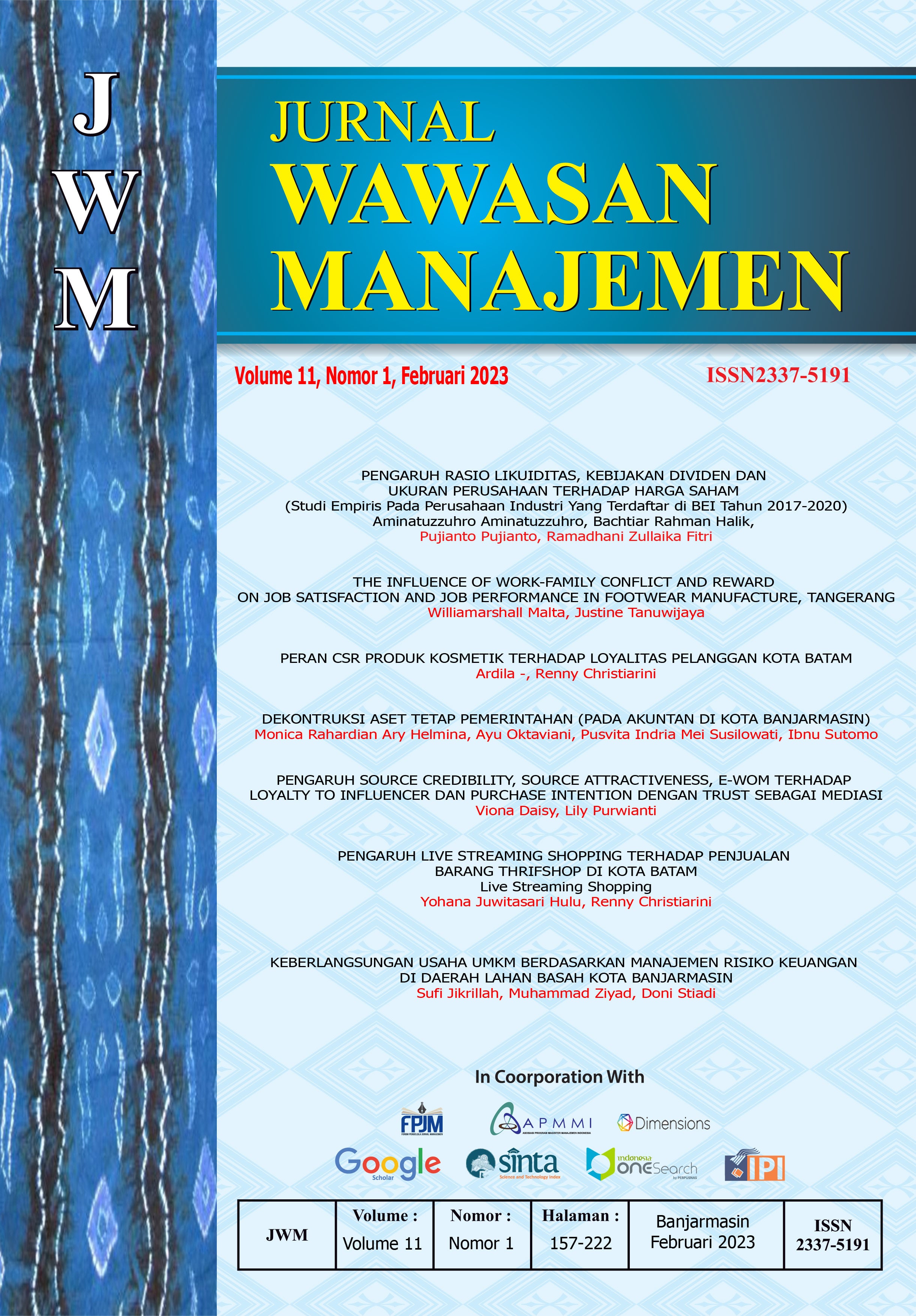
DEKONTRUKSI ASET TETAP PEMERINTAHAN (PADA AKUNTAN DI KOTA BANJARMASIN)
DOI:
https://doi.org/10.20527/jwmthemanagementinsightjournal.v11i1.249Keywords:
Fixed assets, fixed assets in the public sector, Jacques Derrida's DeconstructionAbstract
The purpose of this study is to deconstruct the understanding of fixed assets in government institutions, using deconstructive semiotic studies based on Jacques Derrida's philosophy. Specifically, the research objectives are First, to understand the interpretation of financial statement providers on fixed assets, and evaluate their understanding of the concept of fixed assets applied in accounting. Second, carrying out a search for meaning (semiotics) structurally and deconstructive on the interpretation of fixed assets to reveal the structural reality that appears on the surface and is hidden behind the interpretation. This type of research is qualitative. Respondents were accountants in Banjarmasin, consisting of teaching accountants, government accountants, management accountants and public accountants.
The results of the study concluded that accountants clearly understood the definition of fixed assets, especially government fixed assets. The structural meaning of semiotics Assets are all economic resources as a result of past events that have been controlled, owned by the government, assets have future economic and social benefits that will be achieved, either by the government or the community. Assets can be measured in terms of money, as well as non-financial resources. Necessary for the provision of services to the general public and these resources are maintained due to history and culture. Assets can be purchased on the APBD. Government assets that are the property of the government are obtained from past activities that are used for economic or social activities and are continuously used by the government. Assets can be measured in units of money, non-financial useful life of more than 12 months. Intended for use, in government or public activities. This finding has a fundamental contribution to the field of accounting science because it provides semiotic fundamental ideas for accounting standard setting policies
Downloads
References
Barton, A. 2005. The conceptual arguments concerning accounting for public heritage assets: a note. Accounting, Auditing & Accountability Journal 18.3 (2005): 434-440. 18 (3):434-440.
Barton, A. D. 2000. Accounting for public heritage facilities - assets or liabilities of the government? Accounting, Auditing & Accountability Journal 13 (2):219-235.
BPK RI Perwakilan Jawa Tengah. 2017. Laporan Hasil Pemeriksaan BPK RI atas Laporan Keuangan Pemerintah Daerah Provinsi Jawa Tengah Tahun 2016. LHP Nomor 72A/LHP/BPK/XVIII.SMG/05/2017 tanggal 30 Mei 2017.
BPK RI Perwakilan Jawa Tengah. 2018. Laporan Hasil Pemeriksaan BPK RI atas Laporan Keuangan Pemerintah Daerah Provinsi Jawa Tengah Tahun 2017. LHP Nomor 68A/LHP/BPK/XVIII.SMG/05/2018 tanggal 23 Mei 2018.
Budiyono, Muhtadi, dan Firmansyah. 2015. Dekonstruksi Urusan Pemerintahan Konkuren dalam Undang-Undang Pemerintahan Daerah. Kanun Jurnal Ilmu,Vol 17, No 3.
Byrne. 1994. The Review of Local Government: The Effects on the Management of Property Assets. Property Management, Vol. 12, Issue: 3, pp. 5-8.
Carrigan, C. 1996. Jacques Derrida, Deconstructionism and Postmoderism. Paper Introduction to the Life and Work of Derrida Http://id.wikipedia.org
Creswell, J. W. (2015). Penelitian Kualitatif dan Desain Riset. Memilih di antara Lima Pendekatan (3 Cetakan). Pustaka Belajar, Yogyakarta
Darise, N. 2008. Akuntansi Keuangan Daerah, Jakarta: PT Indeks.
Derrida, J. (2003). Remarks on Deconstruction and Pragmatism 1. In Deconstruction and pragmatism (pp. 77-88). Routledge.
Dewan Standar Akuntansi Keuangan. 2017. Pernyataan Standar Akuntansi Keuangan. Jakarta: IAI.
Huberman, M. (1992). Analisis data kualitatif. Jakarta: UI Pres, TT.
Helmina, M. R. A., & Raysalefty, E. N. Usaha Peningkatan Kualitas Lingkungan Hidup Berdasar Analisis Kelayakan Investasi dalam Belanja Modal. Jurnal Wawasan Manajemen 10 (1)
Kieso, Donald E., Weygandt, Jerry J., Kell, Walter G. 1996. Accounting Principles. Edisi ke-4. New Jersey: Jhon Wiley & Son.
Mardiasmo. 2009. Akuntansi Sektor Publik. Yogyakarta: Andi Yogyakarta.
Mills, L. F., & Newberry, K. J. (2001). The influence of tax and nontax costs on book‐tax reporting differences: Public and private firms. Journal of the American Taxation Association, 23(1), 1-19.
Ngoc, B. T. (2020). Impact of factors on fair value accounting: Empirical study in Vietnam. Investment Management and Financial Innovations,17(3), 10–26. https://doi.org/10.21511/imfi.17(3).
Peraturan Pemerintah Nomor 28 Tahun 2020 tentang Perubahan atas PP Nomor 27 Tahun 2014 tentang Pengelolaan Barang Milik Negara/Daerah
Ranuba, E. D. S., S. Pangemanan, and S. Pinatik. 2015. Analisis Kesiapan Penerapan Standar Akuntansi Pemerintah Berbasil Akrual Berdasarkan No.71 Tahun 2010 Pada DPKPA Minahasa Selatan, Jurnal EMBA 3 (1): 388-397.
Stanton, P., and P. Stanton. 1997. Governmental accounting for heritage assets: economic, social implications. . International Journal of Social Economics 24 (7):988-1006.
Bogt, H., & Tillema, S. (2016). Accounting for trust and control: Public sector partnerships in the arts. Critical Perspectives on Accounting, 37, 5-23.
Yuniarto, A. (2020). Melihat Perlunya Pemerintah Melakukan Program Revaluasi Aset. Jurnal Pajak Dan Keuangan Negara, 2(1), 1–8.
Downloads
Published
Issue
Section
License
Copyright (c) 2023 JWM (JURNAL WAWASAN MANAJEMEN)

This work is licensed under a Creative Commons Attribution 4.0 International License.