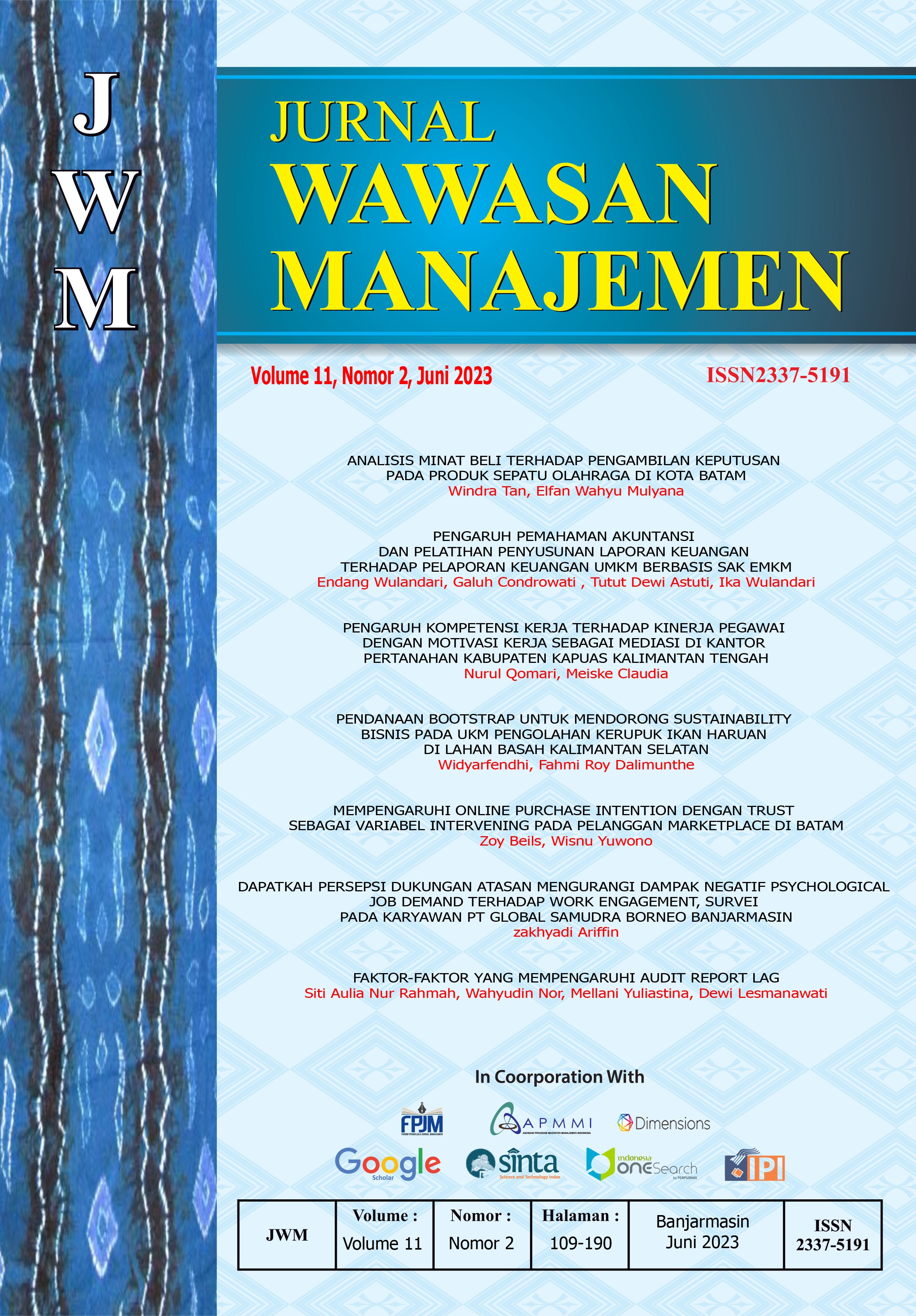
DAPATKAH PERSEPSI DUKUNGAN ATASAN MENGURANGI DAMPAK NEGATIF PSYCHOLOGICAL JOB DEMAND TERHADAP WORK ENGAGEMENT, SURVEI PADA KARYAWAN PT GLOBAL SAMUDRA BORNEO BANJARMASIN
DOI:
https://doi.org/10.20527/jwmthemanagementinsightjournal.v11i2.263Keywords:
Psychological Job Demands, Work Engagement, Perceived Supervisor Support.Abstract
The purpose of this study was to investigate the effect of psychological job demand on work engagement and the moderating role of perceived supervisor support to reduce the impact of psychological job demand on work engagement. The survey was conducted on 64 employees from PT. Global Ocean Borneo in Banjarmasin. Data analysis used regression analysis with moderation. The findings of this study reinforce many previous studies where it has been proven that a negative psychological effect of job demand has a negative effect on work engagement. Other results show that perceived supervisor support does not play a role in reducing the effect of psychological job demand on work engagement among employees.
Downloads
References
Bakker, A. B., & L. M. P. (2010). Work Engagement: A Handbook of Essential Theory and Research. (L. M. P. Bakker, Arnold B., Ed.). New York: Psycholoy Press.
Bakker, A. B., Schaufeli, W. B., Leiter, M. P., & Taris, T. W. (2008). Work engagement: An emerging concept in occupational health psychology. Work and Stress, 22(3), 187–200. https://doi.org/10.1080/02678370802393649
Burns, K. L. (2016). Perceived Organizational Support and Perceived Supervisor Support as Antecedents of Work Engagement. San Jose State University SJSU ScholarWorks, 1–57. Diambil dari https://scholarworks.sjsu.edu/cgi/viewcontent.cgi?article=8225&context=etd_theses
Chan, R., Zamralita, Z., & Markus, R. (2020). Pengaruh Dukungan Sosial Sebagai Moderator Ketidakseimbangan Kehidupan-Kerja Dan Keterikatan Kerja Perawat. Jurnal Muara Ilmu Sosial, Humaniora, dan Seni, 4(2), 339.
Chen, Y., Li, S., Xia, Q., & He, C. (2017). The relationship between job demands and employees’ counterproductive work behaviors: The mediating effect of psychological detachment and job anxiety. Frontiers in Psychology, 8(OCT), 1–15. https://doi.org/10.3389/fpsyg.2017.01890
de Lange, A. H., Van Yperen, N. W., Van der Heijden, B. I. J. M., & Bal, P. M. (2010). Dominant achievement goals of older workers and their relationship with motivation-related outcomes. Journal of Vocational Behavior, 77(1), 118–125. https://doi.org/10.1016/j.jvb.2010.02.013
Montgomery, A., Spânu, F., Bəban, A., & Panagopoulou, E. (2015). Job demands, burnout, and engagement among nurses: A multi-level analysis of ORCAB data investigating the moderating effect of teamwork. Burnout Research, 2(2–3), 71–79. https://doi.org/10.1016/j.burn.2015.06.001
Peeters, M. C. W., Montgomery, A. J., Bakker, A. B., & Schaufeli, W. B. (2005). Balancing work and home: How job and home demands are related to burnout. International Journal of Stress Management, 12(1), 43–61. https://doi.org/10.1037/1072-5245.12.1.43
Rhoades, L., & Eisenberger, R. (2002). Perceived organizational support: A review of the literature. Journal of Applied Psychology, 87(4), 698–714. https://doi.org/10.1037/0021-9010.87.4.698
Rhodes, Linda, Robert Eisenberger and Stephen Armelli, 2001, Affevtive Commitment to The Organization: The Contribution of Perceived Organizational Support, Journal of Applied Psychology, Vol.86 No. 05, 825-836.
Salanova, M., & Schaufeli, W. B. (2008). A cross-national study of work engagement as a mediator between job resources and proactive behaviour. The International Journal of Human Resource Management, 19(1), 116–131. https://doi.org/10.1080/ 09585190701763982
Sale, J. E. M., & Kerr, M. S. (2002). The psychometric properties of Karasek’s demand and control scales within a single sector: Data from a large teaching hospital. International Archives of Occupational and Environmental Health, 75(3), 145–152. https://doi.org/10.1007/s004200100289
Satata, D. B. M. (2021). Pengaruh Job Demands Terhadap Work Engagement Dimoderasi Dukungan Sosial. Thesis, (April), 1–46. Diambil dari https://eprints.umm.ac.id/74762/
Schaufeli, W. B., & Bakker, A. B. (2004). Utrecht work engagement scale Preliminary Manual Version 1.1. Occupational Health Psychology Unit Utrecht University, (December), 1–60. https://doi.org/10.1037/t01350-000
Schaufeli, Wilmar B., Shimazu, A., Hakanen, J., Salanova, M., & De Witte, H. (2019). An ultra-short measure for work engagement: The UWES-3 validation across five countries. European Journal of Psychological Assessment, 35(4), 577–591. https://doi.org/10.1027/1015-5759/a000430
Willemse, B. M., de Jonge, J., Smit, D., Depla, M. F. I. A., & Pot, A. M. (2012). The moderating role of decision authority and coworker- and supervisor support on the impact of job demands in nursing homes: A cross-sectional study. International Journal of Nursing Studies, 49(7), 822–833. https://doi.org/10.1016/j.ijnurstu.2012.02.003
Downloads
Published
Issue
Section
License
Copyright (c) 2023 JWM (JURNAL WAWASAN MANAJEMEN)

This work is licensed under a Creative Commons Attribution 4.0 International License.