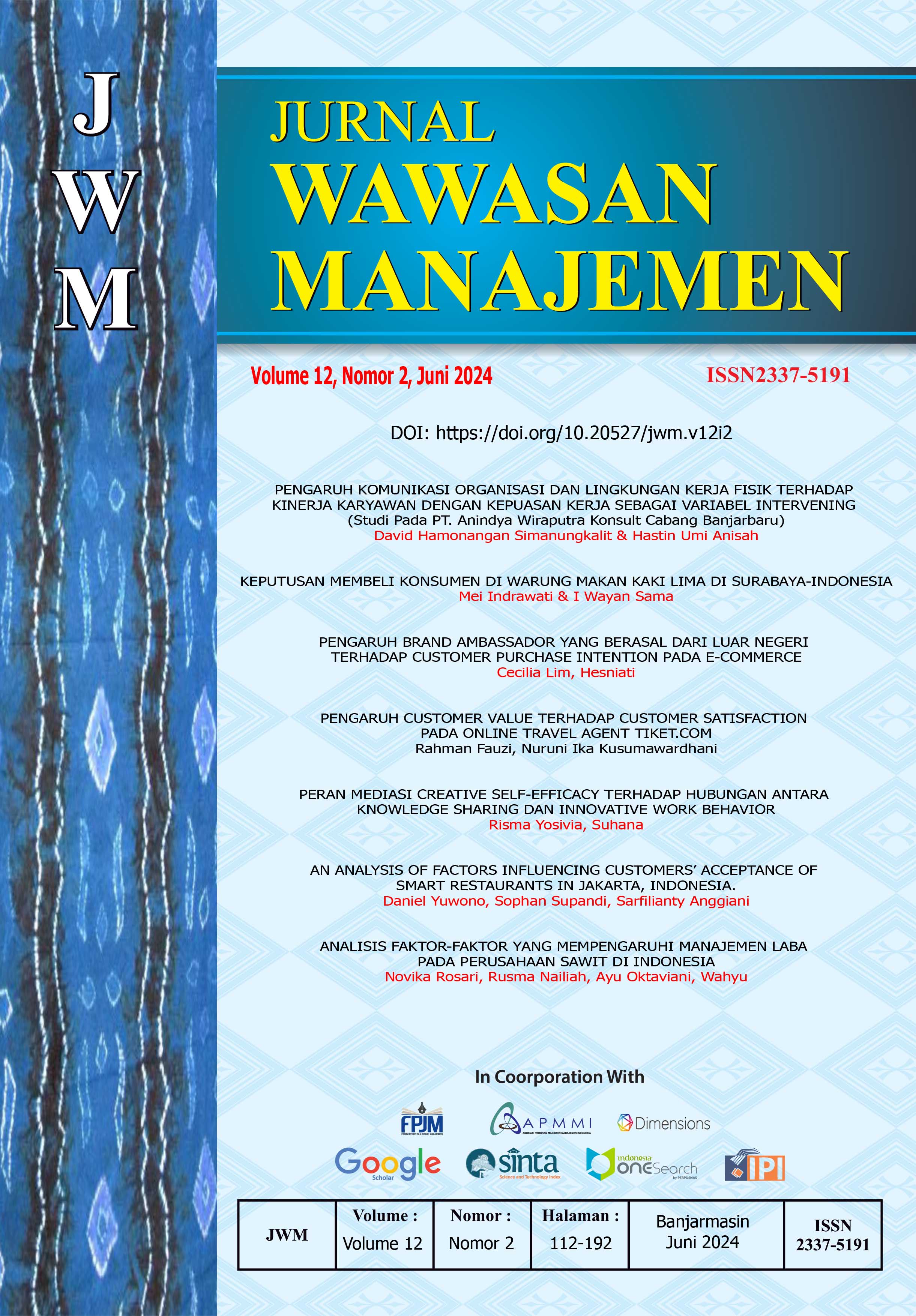
PERAN MEDIASI CREATIVE SELF-EFFICACY TERHADAP HUBUNGAN ANTARA KNOWLEDGE SHARING DAN INNOVATIVE WORK BEHAVIOR
DOI:
https://doi.org/10.20527/jwmthemanagementinsightjournal.v12i2.288Keywords:
Creative self-efficacy, Knowledge sharing, Innovative work behaviorAbstract
ABSTRACT
This research aims to explore the mediating role of creative self-efficacy in the relationship between knowledge sharing and innovative work behavior among students at the Faculty of Economics and Business, Stikubank University in Semarang. The sampling method used was Non-Probability Sampling with a purposive sampling approach, involving students from the 3rd to 8th semesters. The study highlights that creative self-efficacy significantly mediates the relationship between knowledge sharing and innovative work behavior. The implications of these findings underscore the importance of creative self-efficacy as a mediator facilitating the development of innovative behavior through a knowledge-sharing culture in an academic environment. This research has theoretical and practical implication.
Keywords: Creative self-efficacy, Knowledge sharing, Innovative work behavior
ABSTRAK
Penelitian ini bertujuan untuk mengeksplorasi peran mediasi dari efikasi diri kreatif dalam hubungan antara berbagi pengetahuan dan perilaku kerja inovatif pada mahasiswa Fakultas Ekonomi dan Bisnis Universitas Stikubank Semarang. Metode pengambilan sampel yang digunakan adalah Non-Probability Sampling dengan pendekatan purposive sampling yang melibatkan mahasiswa semester 3 hingga 8. Hasil penelitian menyoroti bahwa efikasi diri kreatif memiliki peran mediasi yang signifikan dalam memperkuat hubungan antara berbagi pengetahuan dan perilaku kerja inovatif. Implikasi dari temuan ini menggarisbawahi pentingnya efikasi diri kreatif sebagai penengah yang memfasilitasi pengembangan perilaku inovatif melalui budaya berbagi pengetahuan di lingkungan akademik. Penelitian ini memiliki implikasi teoritis dan praktis.
Kata Kunci: Efikasi diri kreatif, Berbagi pengetahuan, Perilaku kerja inovatif
Downloads
References
Ahmad, Shabir, & N., & Shehzad. (2022). How do environmental innovations and energy productivity affect the environment? Analyzing the role of economic globalization. International Journal of Rnviromental Scieance and Technology, 19, 7527–7538. https://doi.org/https://doi.org/10.1007/s13762-021-03620-8
Al Wali, J., Muthuveloo, R., & Teoh, A. P. (2022). Unravelling the nexus between creative self-efficacy, humble leadership, innovative work behaviour and job performance amongst physicians in public hospitals. Asia-Pacific Journal of Business Administration, 14(4), 706–726. https://doi.org/10.1108/APJBA-05-2021-0205
Asurakkody, T. A., & Kim, S. H. (2020). Effects of knowledge sharing behavior on innovative work behavior among nursing Students: Mediating role of Self- leadership. International Journal of Africa Nursing Sciences, 12(May 2019), 100190. https://doi.org/10.1016/j.ijans.2020.100190
Bozdogan, S. C. (2023). The Mediating Role of Creative Self-Efficacy in The Relationship Between Knowledge Sharing Behavior and Employee Innovation Behavior: A Study in The Recycling Industry. Bingöl Üniversitesi İktisadi ve İdari Bilimler Fakültesi Dergisi, 7(1), 137–153. https://doi.org/10.33399/biibfad.1212900
Caineastellano, S., Chandavimol, K., Khelladi, I., & Orhan, M. A. (2021). Impact of self-leadership and shared leadership on the performance of virtual R&D teams. Journal of Business Reaserch, 128, 578–586. https://psycnet.apa.org/doi/10.1016/j.jbusres.2020.12.030
Chandran, V. G. R., Rasiah, R., & Wad, P. (2009). Malaysian Manufacturing Systems of Innovation and Internationalization of R&D. In CBDS Working Paper Series (Issue 11).
Chughtai, M. S., & Khalid, Y. (2023). Learning organizations and innovative work behaviors: A moderated mediation model from the perspective of social schema theory. Organizatsionnaya Psikhologiya, 13(2), 207–229. https://doi.org/10.17323/2312-5942-2023-13-2-207-229
Cundawan, A., Marchyta, N. K., & Santoso, T. (2021). Mediating effect of creative self-efficacy on the influence of knowledge sharing towards innovative work behavior among millennial knowledge workers. Jurnal Manajemen Dan Pemasaran Jasa, 14(2), 149–164. https://doi.org/10.25105/jmpj.v14i2.8873
Elsahn, Z., Callagher, L., Husted, K., Korber, S., & Siedlok, F. (2020). Are rigor and transparency enough? Review and future directions for case studies in technology and innovation Management. R and D Management, 50(3), 309–328. https://doi.org/10.1111/radm.12412
Erik Stam. (2013). Knowledge and entrepreneurial employees: a country-level analysis. Small Business Economics, 41(4), 887–898. https://econpapers.repec.org/article/kapsbusec/v_3a41_3ay_3a2013_3ai_3a4_3ap_3a887-898.htm
Färber, A. S., & Nazneen Islam, R. (2021). Information and Communication Technology Professionals’ Perceptions of High Inolvement Work Practices and Their Work Engagement - An investigation of the roles of work-life balance and psychological job demands. Gothenburg University. http://hdl.handle.net/2077/69486
Farmer, S. M. (2017). Creative self-efficacy : potential antecedents and relationship to creative performance Creative Self-Efficacy : It’s Potential and Antecedents. 45(January 2002), 1137–1148.
Gaile, A., Baumane-Vitolina, I., Kivipold, K., & Agnis Stibe. (2022). Examining Subjective Career Success of Knowledge Workers. Review of Managerial Science, 16 (7), 2135–2160. https://doi.org/https://link.springer.com/article/10.1007%2Fs11846-022-00523-x
Ghozali, I., & Latan, H. (2015). Partial least squares konsep, teknik dan aplikasi menggunakan program SmartPLS 3.0 untuk penelitian empiris. Badan Penerbit Universitas Diponegoro.
Hair, J. F., Risher, J. J., Sarstedt, M., & Ringle, C. M. (2019). When to use and how to report the results of PLS-SEM. European Business Review, 31(1), 2–24. https://doi.org/10.1108/EBR-11-2018-0203
Hu, B., & Zhao, Y. (2016). Creative self-efficacy mediates the relationship between knowledge sharing and employee innovation. Social Behavior and Personality, 44(5), 815–826. https://doi.org/10.2224/sbp.2016.44.5.815
Khan, H. S. ud din, Li, P., Chughtai, M. S., Mushtaq, M. T., & Zeng, X. (2023). The role of knowledge sharing and creative self-efficacy on the self-leadership and innovative work behavior relationship. Journal of Innovation and Knowledge, 8(4), 100441. https://doi.org/10.1016/j.jik.2023.100441
Knezović, E., & Drkić, A. (2021). Innovative work behavior in SMEs: the role of transformational leadership. Employee Relations, 43(2), 398–415. https://doi.org/10.1108/ER-03-2020-0124
Lukes, M., & Stephan, U. (2017). Measuring employee innovation: A review of existing scales and the development of the innovative behavior and innovation support inventories across cultures. International Journal of Entrepreneurial Behavoir, 23(1), 1355–2554. https://www.emerald.com/insight/content/doi/10.1108/IJEBR-11-2015-0262/full/html
Munir, R., & Beh, L. S. (2019). Measuring and enhancing organisational creative climate, knowledge sharing, and innovative work behavior in startups development. Bottom Line, 32(4), 269–289. https://doi.org/10.1108/BL-03-2019-0076
Oppi, C., Bagheri, A., & Vagnoni, E. (2020). Antecedents of innovative work behaviour in healthcare: does efficacy play a role? International Journal of Public Sector Management, 33(1), 45–61. https://doi.org/10.1108/IJPSM-12-2018-0267
Rasiah, R., & Yap, X.-S. (2016). Innovation Performance of the Malaysian Economy. The Global Innovation Index 2015, 139.
Scott, S. G., & Bruce, R. A. (1994). Determinants of Innovative Behavior: A Path Model of Individual Innovation in the Workplace. Academy of Management Journal, 37(3), 580–607. https://doi.org/10.5465/256701
Shabir, M., Jiang, P., Shahab, Y., & Wang, P. (2023). Geopolitical, economic uncertainty and bank risk: Do CEO power and board strength matter? 87. https://doi.org/https://doi.org/10.1016/j.irfa.2023.102603
Suhana, S., Udin, U., Suharnomo, S., & Mas’ud, F. (2019). Transformational leadership and innovative behavior: The mediating role of knowledge sharing in Indonesian private university. International Journal of Higher Education, 8(6), 15–25. https://doi.org/10.5430/ijhe.v8n6p15
Usmanova, N., Yang, J., Sumarliah, E., Khan, S. U., & Khan, S. Z. (2020). Impact of knowledge sharing on job satisfaction and innovative work behavior: the moderating role of motivating language. VINE Journal of Information and Knowledge Management Systems, 51(3), 515–532. https://doi.org/10.1108/VJIKMS-11-2019-0177
Van Den Hooff, B., & Ridder, J. A. (2004). Knowledge sharing in context: The influence of organizational commitment, communication climate and CMC use on knowledge sharing. Journal of Knowledge Management, 8(6), 117–130. https://doi.org/10.1108/13673270410567675
Downloads
Published
Issue
Section
License
Copyright (c) 2024 JWM (JURNAL WAWASAN MANAJEMEN)

This work is licensed under a Creative Commons Attribution 4.0 International License.