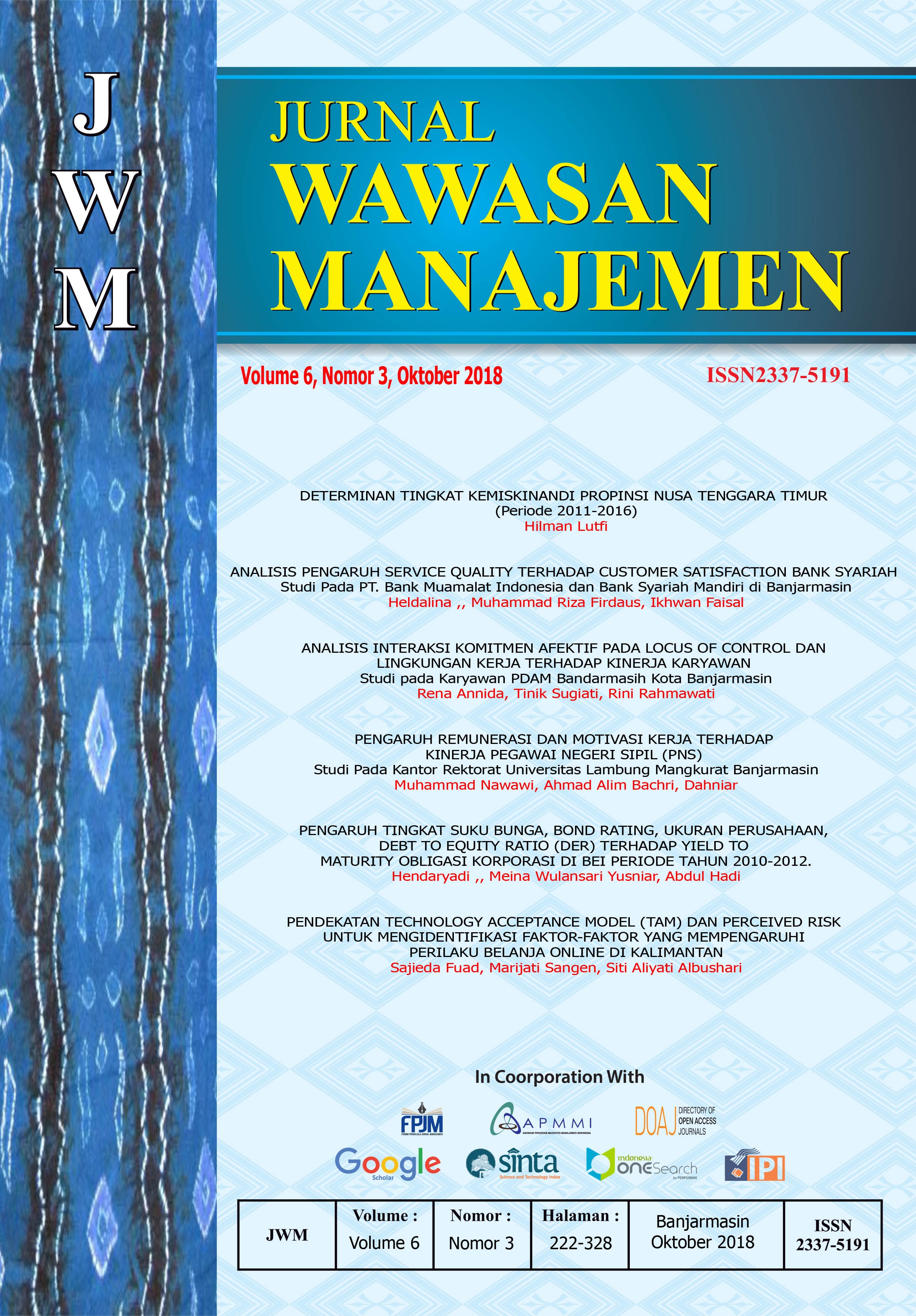
PENDEKATAN TECHNOLOGY ACCEPTANCE MODEL (TAM) DAN PERCEIVED RISK UNTUK MENGIDENTIFIKASI FAKTOR-FAKTOR YANG MEMPENGARUHI PERILAKU BELANJA ONLINE DI KALIMANTAN
DOI:
https://doi.org/10.20527/jwmthemanagementinsightjournal.v6i3.81Keywords:
Structural Equation Model (SEM), Online Shoopping, Business-to-Consumer (B2C) E-Commerce, Technology Acceptance Model (TAM), Perceived RiskAbstract
Internet in Indonesia has a very diverse usage in various aspects of life. One of them is that it can be used in economic transaction that is buying and selling online or better known as e-commerce (electronic commerce). This study aims to factors are perceived usefulness, perceived ease of use, perceived risk, attitude toward using, and behavioral intention.
This research was conducted in Kalimantan. The samples of the research were determined using non-probability sampling method in the form of purposive sampling with the requirements: the samples were at least 18 years of age and they had made purchases of goods or services through online shopping site of B2C e- commerce at least twice. The research method used was survey method through primary data collection by distributing online questionnaires through Google Docs. Data analysis was done by SEM (Structural Equation Modeling) with AMOS (Analysis of Moment Structure) 21.0 software.
The result showed that perceived usefulness and perceived ease of use had positive and significant effect on attitude toward using. However, perceived risk did not have a negative and insignificant effect on attitude toward using. Perceived ease of use had a positive and significant effect on perceived usefulness. Perceived usefulness and attitude toward using positively and significantly influenced the behavioral intention of online shopping in Kalimantan. Perceived ease of use was the most dominant variable giving a direct influence on perceived usefulness, perceived usefulness gave the most dominant indirect influence on behavioral
intention
Downloads
References
Aaker, David A, Rajeev Batra, John G. Myers, 1996,Advertising Management, New Jersey: Prentice Hall.
Aberg, Johan dan Nahid Shahmehri, 2000,The Role of Human Web Assistants in E- Commerce: an Analysis and a Usability Study, Internet Research: Electronic Networking Applications and Policy, 10 (2): 114-125.
Ajzen, I & Fishben, Martin, 1991, Understanding Attitudes and Predicting Social Behavior, Prentice- Hall. Englewood Cliffs, N.J.
Akhlaq, Ather & Ejaz Ahmed, 2015,Digital Commerce in Emerging Economies: Factors
Associated with Online Shopping Intentions in Pakistan, University of Edinburgh, UK:
© Emerald Group Publishing Limited 1746-8809, International Journal of Emerging
Markets, Vol. 10 No. 4, 2015, pp. 634-647.
Aljabari, Mohammed, 2016,Online Shopping: An Analysis of Technology Acceptance Model of Jordanian Customers. Jordan: Journal of Arts, Science & Commerce, E- ISSN 2229-
, ISSN 2231- 4172, Vol.– VII, Issue – 4(1), Oct. 2016 [137].
Almousa, M., 2011, Perceived Risk in Apparel Online Shopping: A Multi-Dimensional
Perspective,Canadian Social Science, Vol. 7, No.2, 23-31.
Anonym, 2016,Infografis Penetrasi & Perilaku Pengguna Internet Indonesia. Jakarta: APJII
dan Puskakom UI.
, 2017,Lima Provinsi di Pulau Kalimantan, Retrieved from:
https://id.wikipedia.org/wiki/Kalimantan
, 2017,Top Ecommerce Sites and Apps in Indonesia, Retrieved from:
https://ecommerceiq.asia/top-ecommerce-sites-indonesia/
, 2017, Jumlah Fasilitas Internet Menurut Provinsi, Retrieved from:
https://statistik.kominfo.go.id/
Ariff, Mohd Shoki Md, Michele Sylvester, Norhayati Zakuan, Khalid Ismail, &Kamarudin Mat Ali, 2014, Consumer Perceived Risk, Attitude and Online Shopping Behaviour; Empirical Evidence from Malaysia, Malaysia: IOP Conf. Series: Materials Science and Engineering58(2014) 012007.
Awad, N.F. and Ragowsky, A., 2008, ‘Establishing Trust in Electronic Commerce Through Online Word of Mouth: An Examination Across Genders’, Journal of Management Information Systems / Spring 2008, Vol. 24, No. 4
Bahri, Syamsul dan Fahkry Zamzam, 2014, Model Penelitian Kuantitatif Berbasis SEM-
Amos, Yogyakarta: Deepublish.
Bhatnagar, A. Mirsa, S., & Rao, R. H., 2000,On Risk, Convenience, and Internet Shopping
Behavior,Communications of the ACM, 43 (11), 98-105.
Bhattacherjee, A., 2001,Understanding Information Systems Continuance: An Expectation- Confirmation Model, MIS Quarterly 25: 351-370.
Butt, Irfan, Sadia Tabassam, Neelam Gul Chaudhry, & Khaldoon Nusair, 2016,Using Technology Acceptance Model to Study Adoption of Online Shopping in An Emerging Economy, Sultan Qaboos University Muscat, Oman: Journal of Internet Banking and Commerce, August 2016, vol.21, no.2.
Caroline, Z., 2007,Correlated error terms. Retrieved
from:http://zencaroline.blogspot.com/2007/04/correlated‐error‐terms.html.
Chang, H. & Chen, S., 2008, TheImpact ofOnlineStoreEnvironmentCues onPurchase
Intention: Trust andPerceived Risk As a Mediator, Online. Info. Rev., (6), 818 – 841.
Claudia, I.,2012,Perceived Risk when Buying Online: Evidence from a Semi-structured
Interview, Economics Series, 22(2), 63-73.
Dan,Y.,Taihai,D.,and Ruiming, L., 2007,StudyofTypes,ResourcesandTheir Influential Factors of Perceived Risk.
Davis, F.D., 1989,Perceived Usefulness, Perceived Easy of Use, and User Acceptance of
Informatiom Technology, MIS Quarterly, Vol. 13, No. 5, pp. 319-339.
Davis, F.D, R.P. Bagozzi, and PR. Warshaw, 1989,User Acceptance of Computer Technology: A Comparison of Two Theoretical Models. International Journal Management Machine Studies, August, Vol. 35, No. 8, pp. 982-1003.
Fatimah, Fatimah, Trisniarty Adjeng Moelyati, &Siera Syailendra, 2016, The Impact of Total Quality Management Practice on Employees’ Satisfaction and Performance: The Case ofMass Media’s Employees, Indonesia: Macrothink Institute, International Journal of Human Resource Studies. ISSN 2162-3058,2016, Vol. 6, No. 2.
Fortes, Nuno & Paulo Rita. 2016. Privacy Concerns and Online Purchasing Behaviour: Towards An Integrated Model. Portugal: European Research on Management and Business Economics 22 (2016) 167–176.
Ferdinand, Augusty, 2006,Structural Equation Modelling dalam Penelitian Manajemen, Semarang: Badan Penerbit Univesitas Diponegoro.
, 2014,Metode Penelitian Manajemen, Edisi 5, Semarang: Badan
Penerbit Univesitas Diponegoro.
Franco, Eugine & Bulomine Regi S., 2016, Advantages and Challenges of E-Commerce
Customers and Businesses: in Indian Perspective. © International Journal of Research
– Granthaalayah, Franco et. al., Vol.4 (Iss.3: SE): March, 2016, ISSN- 2350-0530(O)
ISSN- 2394-3629(P), Impact Factor: 2.035 (I2OR).
Ghozali, Imam, 2013, Aplikasi Analisis Multivariate dengan Program SPSS, Edisi Ketujuh, Semarang: Badan Penerbit Universitas Diponegoro.
Hair, Jr., J.F., Anderson, R. E., Tatham, R.L. & Black, W.C., 1998,Multivariate Data
Analysis, New Jersey 07458: Fifth Edition, Prentice-Hall, Inc.
Hasan, B., 2010, Exploring Gender Differences in Online Shopping Attitude, Computers in Human Behaviour, College of Business and Economics, Qatar University, [WWW].elsevier.com/locate/comphumbeh
Hsu, Shu-Hung & Bat-Erdene Bayarsaikhan, 2012,Factors Influencing on Online Shopping Attitude and Intention of Mongolian Consumers, Nanhua University, Taiwan: The Journal of International Management Studies, Volume 7 Number 2, October, 2012.
Javadi, Mohammad Hossein Moshref, Hossein Rezaei Dolatabadi, Mojtaba Nourbakhsh, Amir Poursaeedi, & Ahmad Reza Asadollahi, 2012,An Analysis of Factors Affecting on Online Shopping Behavior of Consumers, University of Isfahan, Iran: International Journal of Marketing Studies; Vol. 4, No. 5; 2012, ISSN 1918-719X E-ISSN 1918-
, Published by Canadian Center of Science and Education.
Juniwati, 2014,Influence of Perceived Usefulness, Ease of Use, Risk on Attitude and Intention to Shop Online, Indonesia: European Journal of Business and Management, ISSN
-1905 (Paper) ISSN 2222-2839 (Online), Vol.6, No.27, 2014.
Kim, I., 2010, Consumer’s Rankings of Risk Reduction Strategies in E-Shopping,
International Journal of Business Research, Vol. 10, No. 3: 143-148.
Kolsaker, Ailsa &Claire Payne, 2002, Engendering trust in e-commerce: a study of gender- based concerns, University of Surrey, Guildford, UK: © Emerald Group Publishing Limited, Marketing Intelligence & Planning, Vol. 20 Iss 4 pp. 206 – 214.
Laudon, Kenneth C. & Jane P. Laudon, 2014, Management Information Systems: Managing
The Digital Firm, Thirteenth Edition, England: Pearson Education Limited.
Malhotra, Naresh K., 2010,Riset Pemasaran: Pendekatan Terapan, Edisi Keempat, Jilid 1, Jakarta: PT. Indeks.
Mufarida, H., 2011, Perilaku Konsumen E-Commerce Di Kalangan Remaja Urban, Universitas Airlangga.
Mulyana, Yusuf Fitra, 2016, Pengaruh Kepercayaan, Persepsi Risiko, dan Keamanan terhadap Minat Beli Konsumen pada Toko Online ( Studi pada Toko Online olx.co.id ), Universitas Negeri Yogyakarta.
Naiyi Ye, 2004, Dimensions of consumer’s perceived risk in online shopping, Journal of
Electronic Science and Technology of China, vol. 2, no. 3, pp. 177-182.
Nunkoo, Robin, T. D. Juwaheer, & Tekranee Rambhunjun, 2013,Applying the Extended Technology Acceptance Model to Understand Online Purchase Behavior of Travelers, Ryerson University, Toronto, Canada: Proceedings of 21st International Business Research Conference 10 - 11 June, 2013, ISBN: 978-1-922069-25-2.
O’Brien, James A., 2005,Pengantar Sistem Informasi: Perspektif Bisnis dan Manajerial, Edisi 12, Jakarta: Salemba Empat.
Pavlou, P. A., & Fygenson, M., 2006,Understanding and predicting electronic commerce adoption: An extension of the theory of planned Behavior, MIS Quarterly, 30(1), 115-
Rafique, Momal, Muhammad Rizwan, Aymen Batool, & Faiza Aslam, 2014,Extending TAM, in Terms of Trust and Attitude towards the Online Shopping Intention, The Islamia University of Bahawalpur, Pakistan: Journal of Public Administration and Governance, ISSN 2161-7104, 2014, Vol.4, No.3.
Rofiq, Ainur, 2007,Pengaruh Dimensi Kepercayaan (Trust) Terhadap Partisipasi Pelanggan E-Commerce (Studi Pada Pelanggan E-Commerce Di Indonesia), Tesis, Universitas Brawijaya, Malang.
Saprikis V., Chouliara A., Vlachopoulou M., 2010, Perceptions towards online shopping: Analyzing the Greek University student’s attitude, Communications of the IBIMA, vol.
, pp. 1-13, 2010
Schiffman, Leon. G & Leslie Lazar Kanuk, 2008,Perilaku Konsumen, Edisi Ketujuh, Jakarta: PT. Indeks.
Singarimbun, Masri, 1981,Metode Penelitian Survey, Pusat Penelitian dan Studi
Kependudukan, Yogyakarta: Universitas Gajah Mada.
Solimun, 2008, Memahami Metode Kuantitatif Mutakhir: Structural Equation Modelling & Partial Least Square, Malang: Program Studi Statistika FMIPA, Universitas Brawijaya.
Sugiyono, 2008,Metode Penelitian Kuantitatif Kualitatif dan R&D, Bandung: Alfabeta. Thompson, H. a., 1991,Personal Computing: Towards a Conceptual Model of Utilization,
MIS Quarterly, 125-143.
Turban, Efraim, Jay E. Aronson, Ting-Peng Liang, 2005,Decision Support Systems and
Intelligent Systems, Seventh Edition, New Delhi: Prentice Hall Inc.
Venkatesh, Viswanath & Davis, F.D., 2000,A Theoretical Extension of the Technology
Acceptance Model: Four Longitudinal Field Studies,Management Science© 2000
INFORMS, Vol. 46, No. 2, February 2000 pp. 186 –204.
Venkatesh, Viswanath, Michael G. Morris, Gordon B. Davis, &Fred D. Davis., 2003, User
Acceptance of Information Technology: Toward a Unified View, MIS Quarterly, Vol.
, No. 3 (Sep., 2003), pp. 425-478.
Widhiarso, Wahyu, 2011, Korelasi Antar Eror dalam SEM: Mendingan Kita Hindari, Fakultas Psikologi UGM.
Winarti, Ch. Endah, 2017, Produk yang Paling Banyak Dibeli Secara Online Serta Alasannya. Retrieved from:https://dosen.perbanas.id/produk-yang-paling-banyak-dibeli- secara-online-serta-alasannya-oleh-ch-endah-winarti/
Wu, Wann-Yih & Ching-Ching Ke, 2015,An Online Shopping Behavior Model Integrating Personality Traits, Perceived Risk, and Technology Acceptance, Taiwan: Social Behavior And Personality, 2015, 43(1), 85-98.
Downloads
Published
Issue
Section
License
Copyright (c) 2022 JWM (JURNAL WAWASAN MANAJEMEN)

This work is licensed under a Creative Commons Attribution 4.0 International License.