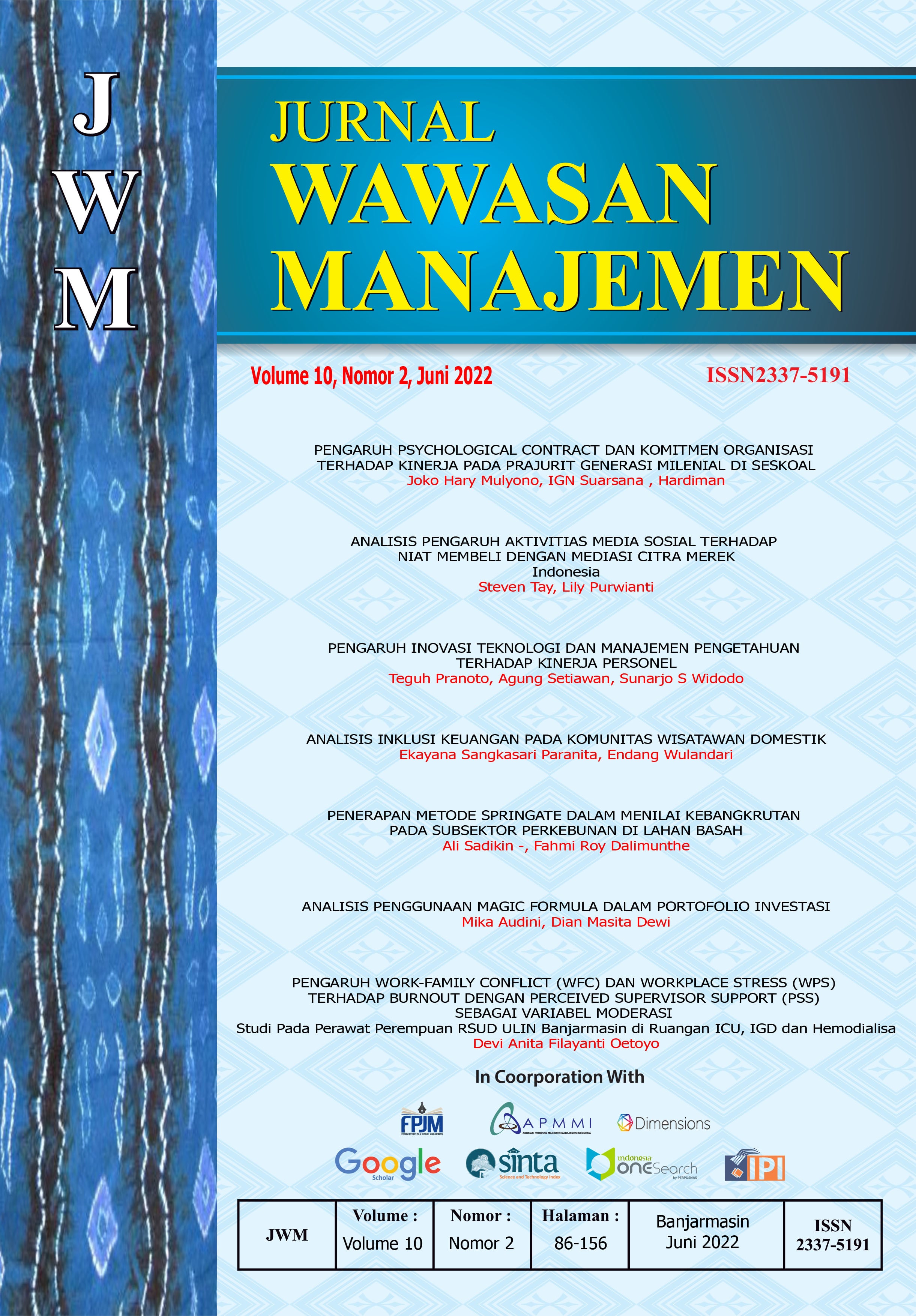
PENGARUH WORK-FAMILY CONFLICT (WFC) DAN WORKPLACE STRESS (WPS) TERHADAP BURNOUT DENGAN PERCEIVED SUPERVISOR SUPPORT (PSS) SEBAGAI VARIABEL MODERASI (Studi Pada Perawat Perempuan RSUD ULIN Banjarmasin di Ruangan ICU, IGD dan Hemodialisa)
Studi Pada Perawat Perempuan RSUD ULIN Banjarmasin di Ruangan ICU, IGD dan Hemodialisa
DOI:
https://doi.org/10.20527/jwmthemanagementinsightjournal.v10i2.214Keywords:
Work-Family Conflict, Workplace Stress, Perceived Supervisor Support, BurnoutAbstract
This research aims to find out and analyze the influence of work-family conflict on burnout, the influence of workplace stress on burnout, the influence of perceived supervisor support on burnout, the role of perceived supervisor support on the influence of work-family conflict on burnout, and the role of perceived supervisor support on the influence of workplace stress on burnout in female nurses at Ulin Hospital Banjarmasin in the ICU, IGD and Hemodialysis Room.
This research is quantitative research with an explanatory research approach. This research method uses a questionnaire with 86 populations, and all of them were determined as samples as respondents. The measurement of variables used Interval Scale and Likert Scale technique with the weights scale from 1 to 5. The data were analyzed using Partial Least Square (PLS). The results of this indicated that (i) there was a significant positive influence of work-family conflict on burnout, (ii) there was a significant positive influence of workplace stress on burnout, (iii) there was a significant positive influence of perceived supervisor support on burnout, (iv) there was a significant negative influence of perceived supervisor support as the moderating variable on the influence of work-family conflict on burnout, and (v) there was a significant positive influence of perceived supervisor support as a moderating variable on the influence of workplace stress on burnout.
Keywords : Work-Family Conflict, Workplace Stress, Perceived Supervisor Support, Burnout
Downloads
References
Abdulkarim, S. A., Musaed, A. f., & M.A., A. (2009). An emprical examination of the effects of self-efficacy, supervisor support and motivation to learn on transfer intention. Management Decision, Vol. 47 Iss 8 pp. 1221 - 1244.
Afshin, S., Hamid Reza, O., Mohammad Reza, A., & Iraj, S. (2012). Co-Workers/Supervisor Suport and Burnout. Interdisiplinary Journal of Contemporary Research in Business, VOL 4, NO 1; 141-148.
Bakker, A. B., Demerouti, E., & Isabel, A. (2014). Burnout and Work Engagement: The JD–R Approach. The Annual Review of Organizational Psychology, doi: 10.1146/annurev-orgpsych-031413-091235, 389–411.
Burns, K. L. (2016). Perceived Organizational Support and Perceived Supervisor Support as Antecedents of Work Engagement. San Jose: Master's Theses and Graduate Research.
Cole, M. S., Bruch, H., & Vogel, B. (2006). Emotion as mediators of the relations between perceived supervisor support and psychological hardiness on employee cynicism. Journal of Organizational Behaviour, DOI: 10.1002/job.381, 463–484.
Eisenberger, R., Stinglhamber, F., Vandenberghe, C., Sucharski, I. L., & Rhoades, L. (2002). Perceived Supervisor Support: Contributions to Perceived Organizational Support and Employee Retention. Journal of Applied Psychology, Vol. 87, No. 3, 565-573.
Frye, N. K., & Breaugh, J. A. (2004). Family-Friendly Policies, Supervisor Suport, Work-Family Conflict, and Satisfaction: a Test of a Conceptual Model. Journal of Business and Psychology, Vol. 19, No. 2, 1-2.
Gibson, J. A., Grey, I. M., & Hastings, R. P. (2009). Supervisor Support as a Predictor of Burnout and Therapeutic Self-Efficacy in Therapists Working in ABA Schools. Springer Science and Business Media, DOI 10.1007/s10803-009-0709-4, 1024–1030.
Greenhaus, J. H., & Beutell, N. J. (1985). Sources of Conflict Between Work and Family Roles. Academy of Management Review, Vul. 10. No 1. 76-88.
Haggstrom, E., Mbusa, E., & Wadensten, B. (2008). Nurses Workplace Distress and Ethical Dilemmas in Tanzanian Health Care. Sage Publications, 10.1177/0969733008090519, 478-491.
Hobfoll, S. E. (2001). The Influence of Culture, Community , and the Nested-Self in Stress Process: Advancing Conservation of Resources Theory. Applied Psychology: An International Review, 337-421.
James, M. (2019). The Impact of Workplace Burnout on Millennial Turnover. The College of St. Scholastica, 1-9.
Jones, A. N., & Wier, B. (2010). Healty lifestyle as a coping mechanism for role stress in public accounting . Behaviour Research in Accounting, 21-41.
Kossek, E. E., Colquitt, J. A., & Noe, R. A. (2001). Caregiving Decisions, Well-Being, And Performance: The Effects of Place and Provider as a Fuction of Dependent Type and Work-Family Climates. Academy of Management Journal, Vol. 44, No. 1, 29-44.
Kottke, J. L., & Sharafinski, C. E. (1988). Measuring Perceived Supervisory and Organizational Suport . Educational and Psychological Measurement, 1075-1079.
Kurniawati, D., & Solikhah. (2012). Hubungan Kelelahan Kerja dengan Kinerja Perawat di Bangsal Rawat Inap Rumah Sakit Islam Fatimah Kabupaten Cilacap . KES MAS, Vol. 6, No. 2, 162-232.
Laschinger, H. K., Leiter, M., Day, A., & Gilin, D. (2009). Workplace empowerment, incivility, and burnout: impact on staff nurse recruitment and retention outcomes. Journal of Nursing Management, 302–311.
Latan, H., & Ghozali, I. (2014). Partial Least Squares, Metode dan Aplikasi Menggunakan Program Warp PLS 4.0. Semarang: Badan Penerbit Universitas Diponegoro .
Maslach, C., & Jackson, S. E. (1981). The measurement of experienced burnout. Journal of occupational behaviour, Vol. 2.99-113, 1-15.
Nazir. (1988). Metode Penelitian. Jakarta: Ghalia Indonesia.
O'Driscoll, M. P., & Cooper, C. L. (2001). Job-related Stress and Burnout. Psychology at Work, 203-228.
Purba, J., Yulianto, A., & Widyanti, E. (2007). Pengaruh Dukungan Sosial Terhadap Burnout Pada Guru. Jurnal Psikologi, Vol. 5, No. 1, 77-87.
Robbins, S. P. (2001). Organizational Behavior. United States of America: Pearson Education.
Shanafelt, T. D. (2012). Burnout and Satisfaction with Work-Life Balance Among US Physicians Relative to the General US Population. Arch Intern Med, VOL 172 (NO. 18).
Sharpley, C. F., Reynolds, R., & Acosta, A. (1996). The presence, nature and effects of job stress on physical and psychological health at a large Australian university. Journal of Educational Administration, Vol. 34 Iss 4 pp. 73 - 86.
Suryana. (2010). Metode Penelitian Model Praktis Penelitian Kuantitatif dan Kualitatif . Bandung : UPI.
Wirakristama, R. C. (2011). Analisis Pengaruh Konflik Peran Ganda (Work-Family Conflict) Terhadap Kinerja Karyawan Wanita Pada PT. Nyonya Meneer Semarang Dengan Stres Kerja Sebagai Variabel Intervening. https://www.researchgate.net/publication/279504011.
Wu, G., Wu, Y., Li, H., & Dan, C. (2018). Job Burnout, Work-Family Conflict and Project Performance for Construction Professionals: The Moderating Role of Organizational Support. International Journal of Environmental Research and Public Health, doi:10.3390/ijerph15122869, 1-20.
Yusuf, A. (2014). Metode Penelitian Kuantitatif Kualitatif dan Penelitian Gabungan . Jakarta: Prenadamedia Group.
Downloads
Published
Issue
Section
License
Copyright (c) 2022 JWM (JURNAL WAWASAN MANAJEMEN)

This work is licensed under a Creative Commons Attribution 4.0 International License.