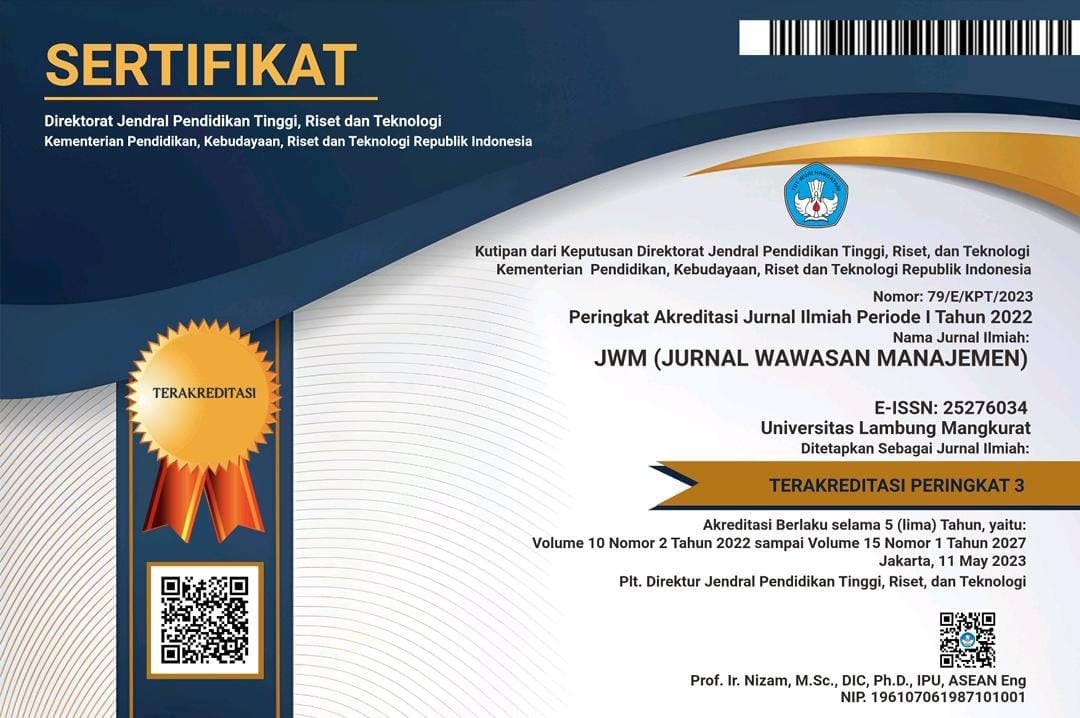
ANALISIS PENGARUH VALUE BASED ADOPTION MODEL TERHADAP NIAT KONSUMEN UNTUK MENGGUNAKAN WEARABLE TECHNOLOGY - SMART WATCH DI INDONESIA PADA MASA PANDEMI COVID-19
DOI:
https://doi.org/10.20527/jwmthemanagementinsightjournal.v9i2.26Keywords:
Wearable Technology, Internet of Things, Value Based Adoption Model, Technology Acceptance ModelAbstract
Wearables technology as a smart complement tobe one of essensial delivery information, function of daily use and healthcare, specially during the COVID 19 pandemic are presented. People have to control their health and do the activities to rise body imunity. Wearables systems significantly reduce the risk of infectious disease transmission. This study aims to comprehensively examine the adoption of wearable technology. A new model VAM (Value-based Adoption Model) combining value and TAM (Technical Acceptance Model) was developed and analyse with a set of variables benefit and sacrefice. Variables benefit consist of usefulness and enjoyment: variables sacrefice consist of technically fee and perceived fee for the wearable technology devices. Using questionaire and using Structural Equation Model analys 262 respondents age between 17-60 years old, many kinds of profesion and knows about wearable technology and using internet. The result shows that Perceived value was affected by perceived usefulness, perceived enjoyment and Technically, but it’s not significance affacted by perceived fee. This study holds considerable significance as it proposes a new approach to IoT (Internet of Things)-based wearable technology adoption using VAM and TAM. Through these model, the study determined that it is imperative for businesses to constitute and secure appropriate the product for people to use IoT-based wearable technology to reduce Covid 19 risk.
Downloads
References
Agarwal, R. and Karahanna, E. (2000) ‘Time Flies When You’re Having Fun: Cognitive Absorption and Beliefs about Information Technology Usage’, MIS Quarterly, 24(4), pp. 665–694. Available at: www.jstor.org/stable/3250951.
Ahmed, J. U. and Chowdhury, H. K. (2013) ‘Consumer Perceptions of Quality towards Beautification Products: A Developing Country Perspective’, IIMS Journal of Management Science, 3(2), p. 205. doi: 10.5958/j.0976-030x.3.2.008.
Andersson, P. and Heinonen, K. (2002) ‘Acceptance of mobile services - insights from the Swedish market for mobile telephony’, (January).
Ann Fogelgren-Pedersen, Kim Viborg Andersen, C. J. (2003) ‘The Paradox of the Mobile Internet: Acceptance of Gadgets and Rejection of Innovations’, 16th Bled eCommerce Conference eTransformation, (December), pp. 903–917. Available at: https://domino.fov.unimb.si/proceedings.nsf/0/603e6ee67fcfc186c1256ea2002eec91/$FILE/64Folgel.pdf.
Baskin, L. (2017) ‘-Care Behaviors as Predictive Factors in the Use of the Emergency Department for Chronic Care Management in Patients with HTN And/Or Diabetes Mellitus Ages 30 …’. Available at: http://search.proquest.com/openview/5765 6ce358d660f19044ccec973fdc13/1?pqorigsite= gscholar&cbl=18750&diss=y
Baker, J. et al. (2002) ‘The Influence of Multiple Store Environment Cues on Perceived Merchandise Value and Patronage Intentions’, 66(April), pp. 120–141.
Davis, F. D., Bagozzi, R. P. and Warshaw, P. R. (1989) ‘User Acceptance of Computer Technology: A Comparison of Two Theoretical Models’, Management Science, 35(8), pp. 982–1003. doi: 10.1287/mnsc.35.8.982.
Chuah, S. H. W. et al. (2016) ‘Wearable technologies: The role of usefulness and visibility in smartwatch adoption’, Computers in Human Behavior. Elsevier Ltd, 65, pp. 276–284. doi: 10.1016/j.chb.2016.07.047.
Deci, E.L., Ryan, R.M., 1991, A Motivational Approach To Self: Integration in Personality. In: Dienstbier, R. (Ed.), Nebraska Symposium on Motivation: Vol. 38, Perspectives on Motivation (Pp. 237–288). Lincoln: University of Nebraska Press.
DeLone, W. H. and McLean, E. R. (2003) ‘The DeLone and McLean Model of Information System Success’, Journal of Management Information Systems, 19(4), pp. 9–30. doi: 10.1080/07421222.2003.11045748.
DeLone, W. H. and McLean, E. R. (2016) Information Systems Success Measurement, Foundations and Trends® in Information Systems. doi: 10.1561/2900000005.
Fishbein, M., & Ajzen, I. (1975) Belief, attitude, intention, and behavior : An introduction to theory and research. Reading, Mass. ; Don Mills. Ontario: Addison-Wesley Pub. Co.
Fishbein, M. (1967) A Behavior Theory Approach to The Relations Between Beliefs About an Object and The Attitude toward The object. In M. Fishbein (Ed.), Readings in Attitude Theory and Measurement. New York: New York: John Wiley & Sons.
Fred D. Davis (1989)‘Perceived, Usefulness, Perceived Ease of Use, and User Acceptance of Information Technology’, MIS Quarterly, 13(3), pp. 319–340. doi:10.1016/j.cell.2017.08.036.
Gardner, C. and Amoroso, D. L. (2004) ‘Development of an instrument to measure the acceptance of Internet technology by consumers’, in. doi: 10.1109/hicss.2004.1265623. Growth from Knowledge (2017) Tech Trends Welcome To Trends 2017.
Hair, J. F. and Black, William, Babin, Barry J., Anderson, R. E. (2014) Univariate Data Analysis, Exploratory Data Analysis in Business and Economics. doi:10.1007/978-3-319-01517-0_3.
Hsiao, K. L. and Chen, C. C. (2018) ‘What drives smartwatch purchase intention? Perspectives from hardware, software, design, and value’, Telematics and Informatics. Elsevier, 35(1), pp. 103–113. doi: 10.1016/j.tele.2017.10.002.
Hunn, N. (2015) ‘The market for smart wearable technology: A consumer centric approach’, WiFore Consulting, (February 2015). Available at: http://www.nickhunn.com/wpcontent/ uploads/downloads/2014/08/The-Market-for-Smart-Wearables.pdf.
Kim, H. and Niehm, L. S. (2009) ‘The Impact of Website Quality on Information Quality,Value, and Loyalty Intentions in Apparel Retailing’, Journal of Interactive Marketing. Elsevier Inc., 23(3), pp. 221–233. doi: 10.1016/j.intmar.2009.04.009.
Kim, H. W., Chan, H. C. and Gupta, S. (2007) ‘Value-based Adoption of Mobile Internet: An empirical investigation’, Decision Support Systems, 43(1), pp. 111– 126. doi: 10.1016/j.dss.2005.05.009.
Kim, S., Bae, J. and Jeon, H. (2019) ‘Continuous Intention on Accommodation Apps: Integrated Value-Based Adoption and Expectation–Confirmation Model Analysis’, Sustainability, 11(6), p. 1578. doi: 10.3390/su11061578.
Kim, Y., Park, Y. and Choi, J. (2017) ‘A study on the adoption of IoT smart home service: using Value-based Adoption Model’, Total Quality Management and Business, Excellence. Taylor & Francis, 28(9–10), pp. 1149–1165. doi: 10.1080/14783363.2017.1310708.
Kwon, H. and Seo, K. (2013) ‘Applicationof Value-based Adoption Model to Analyze SaaS Adoption Behavior in Korean B2B Cloud Market 1’, International Journal ofAdvancements in Computing Technology, 5(12), pp. 368–373.
Lee, J. et al. (2016) ‘Sustainable wearables: Wearable technology for enhancing the quality of human life’, Sustainability (Switzerland), 8(5). doi: 10.3390/su8050466.
Li, H., Ward, R. and Zhang, H. (2006)‘Risk, Convenience, Cost and Online Payment Choice: A Study of eBay Transactions’, Journal Decision Support Systems, 42(2), pp. 1076–1088.
Lucy, J. (2014) ‘The Internet of Things and You’, Electrical Wholesaling, 95(10), pp. 3-n/a. doi: 10.1007/978-1-4842-1293-6_1.
Lynn, K., Supervisor, F. and Hedman, J. (2015) ‘Business Model Framework Proposal for Internet of Things A theoretical research paper on Internet of Things from a business perspective’, 940 (November). Available at: http://studenttheses.cbs.dk/bitstream/handle/10417/5706/katrina_lynn_fugl.pdf?sequence=1.
Maguire, B. (2016) ‘The Value-Based Theory of Reasons’, Ergo, an Open Access Journal of Philosophy, 3(20190214), pp. 233–262. doi: 10.3998/ergo.12405314.0003.009.
Monroe, K. B. (1973). Buyers' Subjective Perceptions of Price. Journal of Marketing Research , 10 (1), 70-80.
Monroe, K. B., & Chapman, J. D. (1987). Framing Effects on Buyers' Subjective Product Evaluations. Advances in Consumer Research, 14 , 193-197. Pricewaterhouse Coopers (2014) the-wearablefuture.
Prins, R. (2008) Modeling Consumer Adoption and Usage of Value-Added Mobile Services, Economics Management. Available at: http://repub.eur.nl/publications/eco_man/index/426913443/.
Richard Thaler (1985) ‘Mental Accounting and Consumer Choice’, Marketing Science, 4(3), pp. 199–214.
Rogers, E. M. (1995) ‘Diffuison of Innovations’, Elements of Diffusion 3rd. Edition. 4th edn. Edited by Auflage. New York: The Free Press, pp. 1–37. doi: citeulike-articleid: 126680.
Ryza, P. (2015), Memasyarakatkan Perangkat Wearable dan Internet of Things di Indonesia.
Shin, D. H. (2007) ‘User acceptance of mobile Internet: Implication for convergence
technologies’, Interacting with Computers, 19(4), pp. 472–483. doi: 10.1016/j.intcom.2007.04.001.
Sirdeshmukh, D., Singh, J. and Sabol, B. (2002) ‘Consumer Trust, Value, and Loyalty in Relational Exchanges’, Journal of Marketing, 66(1), pp. 15–37. doi: 10.1509/jmkg.66.1.15.18449.
Sweeney, J. C. and Soutar, G. N. (2001) ‘Consumer perceived value: The development of a multiple item scale’, Journal of Retailing, 77(2), pp. 203–220. doi: 10.1016/S0022-4359(01)00041-0.
Teknologi.id (2017) ‘Top 5 Produk Wearable Device Berdasarkan Pengiriman ke Seluruh Dunia pada Tahun 2017’.
Urbany, J. E., Bearden, W. O., Kaicker, A. B. (1997) ‘Transaction utility effects when quality is uncertain’, Journal of the Academy of Marketing Science, 25(:45).
Venkatesh, V. (2006) ‘Creation of Favorable User Perceptions: Exploring the Role of Intrinsic Motivation’, MIS Quarterly, 23(2), p. 239. doi: 10.2307/249753.
Venkatesh, V., Thong, J. Y. L. and Xu, X. (2016) ‘Journal of the A I S Association for Information ystems Unified Theory of Acceptance and Use of Technology: A Synthesis and the Road Ahead’, Journal of the Association for Information Systems, 17(5), pp. 328–376.
Venkatesh, V. and Walton, Sam M Thong, James Y L Xu, X. (2012) ‘Consumer Acceptance and Use Of Information Technology: Extending The Unified Theory of Acceptance and Use of Technology’, 36(1), pp. 157–178.
Voss, G. B., Parasuraman, A. and Grewal, D. (2006) ‘The Roles of Price, Performance, and Expectations in Determining Satisfaction in Service Exchanges’, Journal of Marketing, 62(4), p. 46. doi: 10.2307/1252286.
Wang, X. (2013) ‘Innovative Technology Adoption in the A Case Study from the Personalized Cancer Medicine MSc in Innovation and Entrepreneurship’.
Zeithaml, V. A. (1988) ‘of Consumer Perceptions A Means-End Value : Quality, and and Model Synthesis of Evidence’, Journal of Marketing, 52(July), pp. 2–22. Wearable data analysis, visualisationand recommendations on the go usingandroid middleware
Marios C. Angelides1&Lissette Andrea Cabello Wilson1&Paola Liliana Burneo Echeverría, Received: 2 October 2017 /Revised: 1 March 2018 /Accepted: 4 March 2018 /Published
https://selular.id/2017/11/pengamat-ungkap-tren-wearable-technology-di-indonesia/
https://selular.id/2020/12/catatan-akhir-2020-meramu-taji-wearable-device-manjur-di-2021/
https://www.statista.com/statistics/1054523/indonesia-frequency-of-using-wearable-tech/

Downloads
Published
Issue
Section
License
Copyright (c) 2022 JWM (JURNAL WAWASAN MANAJEMEN)

This work is licensed under a Creative Commons Attribution 4.0 International License.