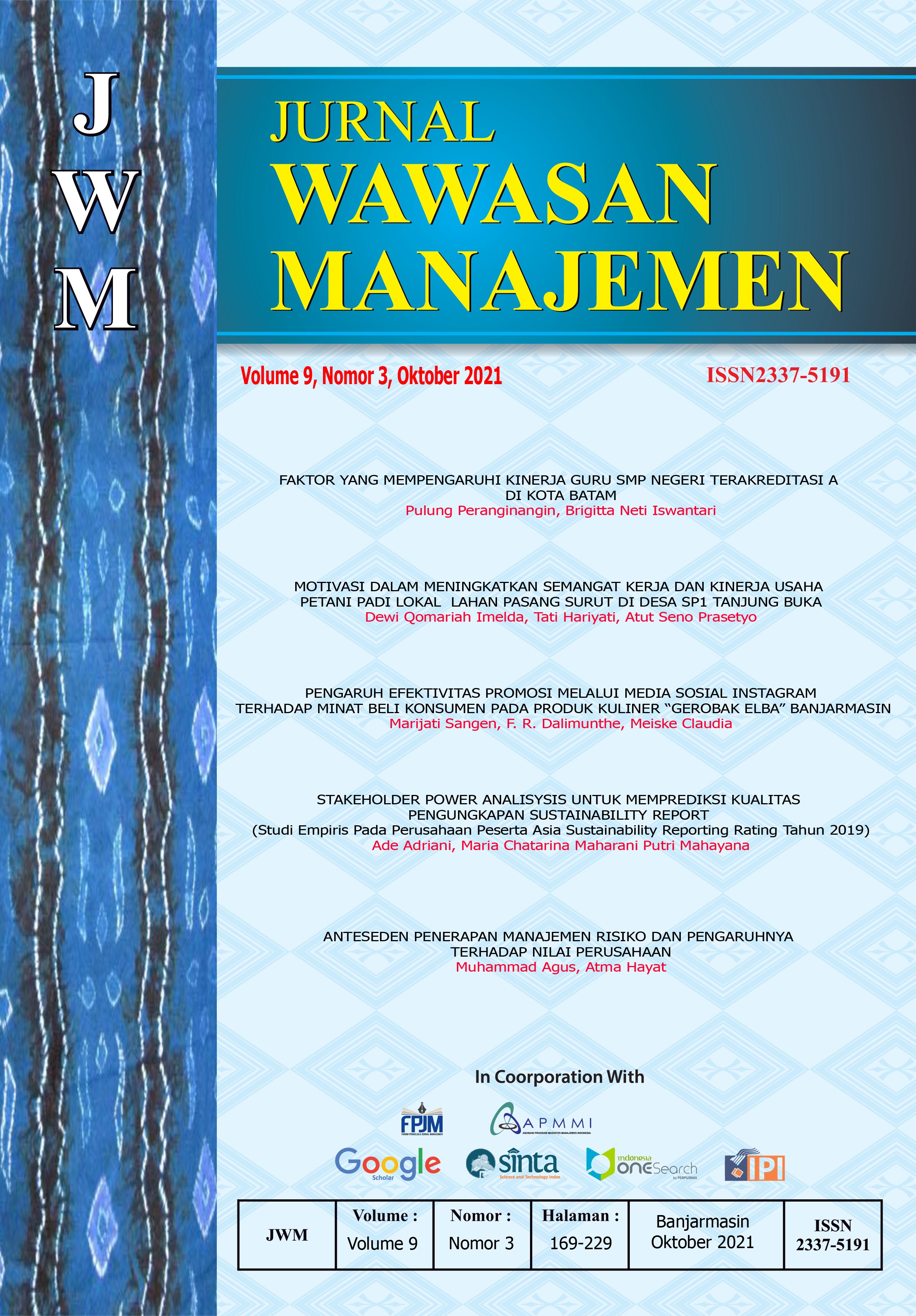
STAKEHOLDER POWER ANALISYSIS UNTUK MEMPREDIKSI KUALITAS PENGUNGKAPAN SUSTAINABILITY REPORT (Studi Empiris Pada Perusahaan Peserta Asia Sustainability Reporting Rating Tahun 2019)
DOI:
https://doi.org/10.20527/jwmthemanagementinsightjournal.v9i3.194Keywords:
stakeholder’s pressure, disclosure, sustainability reportAbstract
This research aims to obtain evidence of the effect of stakeholders’ pressure, such as pressure from consumer, shareholder, creditor, employee, government, mass media, and community and environmental activist toward the quality of company’s sustainability report disclosure in Indonesia. The population in this research were the Indonesian companies that join to be participants in Asia Sustainability Reporting Rating (ASRRAT) 2019. This research used the purposive sampling method. Data were analyzed by ordinal logistic regression using IBM SPSS 24. The result showed that the pressure from community and environmental activist improves the quality of sustainability report disclosure. It means that higher the pressure from consumer, community and environmental activist to company will increase the quality of sustainability reporting disclosure. On other hand, the pressure from shareholder, creditor, employee, government and mass media to quality of company’s sustainability report disclosure influence with a lower level of confidence. Stakeholder pressure affects the quality of sustainability report disclosure by 44,6%, while 55,4% level of quality can be influenced by other factors
Downloads
References
Agoes, S., & Ardana, I. C. (2014). Etika Bisnis dan Profesi: Tantangan Membaangun Manusia Seutuhnya. Jakarta: Salemba Empat.
Alfaiz, D. R., & Aryati, T. (2019). Pengaruh Tekanan Stakeholder dan Kinerja Keuangan terhadap Kualitas Sustainability Report dengan Komite Audit sebagai Variabel Moderasi. Jurnal Elkington, J. (1998). Accounting for the Triple Bottom Line. Measuring Business Excellence, 2(3), 18-22.
Akuntansi dan Keuangan Methodist, 2(2), 112-130.
Azheri, B. (2011). Corporate Social Responsibility: Dari Voluntary Menjadi Mandatory. Jakarta: Rajawali Press.
Badrianto, Y., Pratiwi, R., Ernawati, A., Hutar, A. N., Manafe, M. W., & Ahdiyat, M. (2021). Mengelola SDM Produktif dan Unggul. Bandung: Media Sains Indonesia.
Elkington, J. (1998). Accounting for the Triple Bottom Line. Measuring Business Excellence, 2(3), 18-22.
Fernandez-Feijoo, B., & Romero, S. R. (2012). Effect of Stakeholders' Pressure on Transparency of Sustainability Reports within the GRI Framework. Journal of Business Ethics, 122(1), 56-63.
Ghozali, I. (2018). Aplikasi Analisis Multivariate dengan Program IBM SPSS 25 (Edisi 9). Semarang: Badan Penerbit Universitas DIponegoro.
Global Reporting Initiative. (2018). GRI 101: Landasan 2016. Diambil kembali dari Global Reporting Initiative Web Site: https://www.globalreporting.org/standards/media/1529/bahasa-indonesia-gri-101-foundation-2016.pdf
Hunardy, N., & Tarigan, J. (2017). Pengaruh Kepemilikan Pemerintah terhadap Kinerja Keuangan Melalui Dewan Komisaris Independen sebagai Variabel Intervening. Business Accounting Review, Volume 5(2), 601-612.
Ikatan Akuntan Indonesia (IAI). (2018). Pernyataan Standar Akuntansi Keuangan (PSAK) No.1. Penyajian Laporan Keuangan. Jakarta: IAI.
Kadri, T. (2018). Rancangan Penelitian. Yogyakarta: Deepublish.
Kasmir. (2016). Analisis Laporan Keuangan. Jakarta: Raja Grafindo.
Keraf, A. S. (1998). Etika Bisnis. Yogyakarta: Kanisius.
Lulu, C. L. (2020). Stakeholder Pressure and The Quality of Sustainability Report: Evidence from Indonesia. Journal of Accounting, Entrepreneurship and Financial Technology, Vol 2 (1), 39-53.
Nuraini. (2019). Non Debt Tax Shield, Biaya CSR, Komisaris Independen, Komite Audit dan Tindakan Penghindaran Pajak Oleh Bank yang Terdaftar di BEI. Jurnal Fairness, Volume 9(2), 145-158.
Paewsti, R., & Wikansari, R. (2016). Pengaruh Kepuasan Kerja Terhadap Intensi Turnover Karyawan di Indonesia. Jurnal Ecopsy, Volume 3(2), 49-67.
Qisthi, F., & Fitri, M. (2020). Pengaruh Keterlibatan Pemangku Kepentingan terhadap Pengungkapan Laporan Keberlanjutan Berdasarkan Global Reporting Initiative (GRI) G4. Jurnal Ilmiah Mahasiswa Ekonomi Akuntansi (JIMEKA), 5(4), 469-484.
R.E. Freeman , Strategic Management: A Stakeholders Approach, Fitman, Boston, 1984, hlm.37
Rudyanto, A., & Siregar, S. V. (2018). The Effect of Stakeholder Pressure and Corporate Governance on the Quality of Sustainability Report. International Journal of Ethics and System, 34(2), 233-249.
Sigit, T. H. (2012). Etika Bisnis Modern: Pendekatan Pemangku Kepentingan. Yogyakarta: UPP STIM YKPN.
Suharyani, R., Ulum, I., & Jati, A. W. (2019). Pengaruh Tekanan Stakeholder dan Corporate Governance Terhadap Kualitas Sustainability Report. JURNAL AKADEMI AKUNTANSI, 2(1), 71-92.
Suwardjono. (2014). Teori Akuntansi: Perekayasaan Pelaporan Keuangan (Edisi Ketiga). Yogyakarta: BPFE-Yogyakarta.
Weiss, J. W. (2003). Business Ethics: A Stakeholder and Issues Management Approach, 3rd Edition. Ohio: South-Western.
Wolk, H. I., Tearney, M. G., & Dodd, J. L. (2001). Accounting Theory: A Conceptual and Institutional Approach. Ohio: South-Western College Publishing.
Downloads
Published
Issue
Section
License
Copyright (c) 2021 JWM (JURNAL WAWASAN MANAJEMEN)

This work is licensed under a Creative Commons Attribution 4.0 International License.