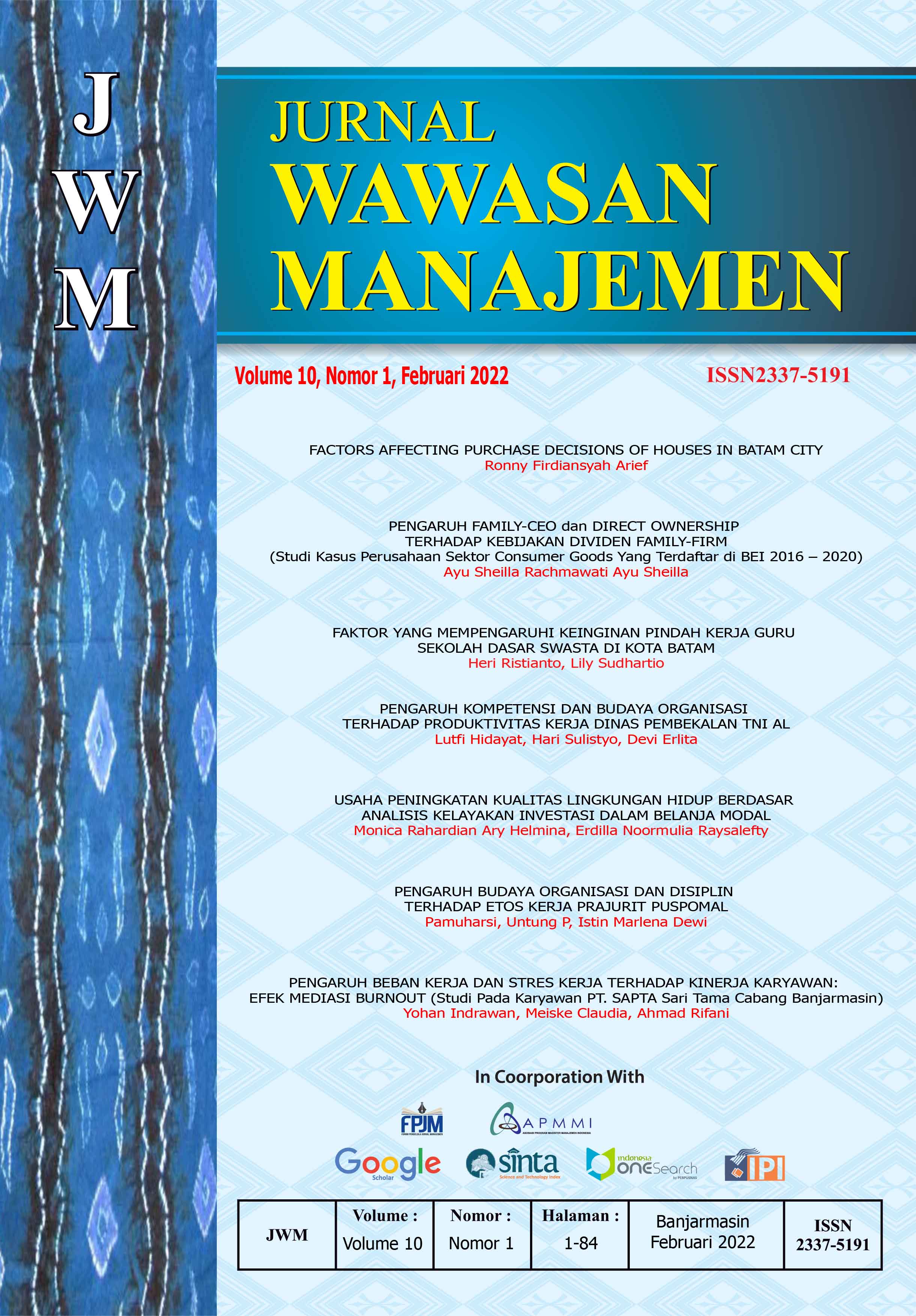
USAHA PENINGKATAN KUALITAS LINGKUNGAN HIDUP BERDASAR ANALISIS KELAYAKAN INVESTASI DALAM BELANJA MODAL
DOI:
https://doi.org/10.20527/jwmthemanagementinsightjournal.v10i1.201Keywords:
Net Present Value (NPV), Nilai Internal Rate of Return (IRR), Cost Benefit Analysis (CBA), Aspek Sosial, Aspek TeknisAbstract
The study was carried out explain the feasibility of the investment plan for additional garbage truck by Banjarmasin Environmental Service, viewed from the investment criteria assessment namely in the term of technical, social and econimic feasibility.
It was a quantitative descriptive study. The data obtained in the form of Budget Execution Document, Local Revenue Receipt Report, Waste Retribution, and direct interview. The analysis technique is: knowing the source of investment funds, creating a forecast of retribution income during the economic age, making a forecast of operating cost over economic age, evaluating investment proposal with technical analysis, social and economic using NPV, IRR, CBA.
The result indicated that (1) From the result of technical aspect and social aspects, the government investment investment for additional garbage truck is feasible to implement. (2) Net Present Value (NPV) method with a social discount rate 9% results negative NPV of Rp.-764.123.860. It means that the investment for additional garbage truck is not feasible. (3) The value of Internal Rate of Return (IRR) is not able to be found since the present value of cost is all negative. So, a positive NPV cannot be found. (4) From Cost Benefit Analysis (CBA) method, comparison result between benefit/cost yields a number of 0.49 which means less than 1. Thus, the feasibility analysis of the investment for additional garbage truck is not feasible.
Downloads
References
Arsyad, L. (2010). Ekonomi Pembangunan. Yogyakarta: UPP STIM YKPN.
Darise, N. (2008). Akuntansi Keuangan Daerah. Jakarta: PT. Indeks.
Halim, A. (2008). Akuntansi Keuangan Daerah. Jakarta: Salemba Empat.
Haming, M., & Basalamah, S. (2010). Studi Kelayakan Investasi Proyek dan Bisnis. Jakarta: Bumi Aksara.
Mardiasmo. (2009). Akuntansi Sektor Publik. Yogyakarta: Andi.
Purhantara, W. (2010). Metode Penelitian Kualitatif Untuk Bisnis. Yogyakarta: Graha Ilmu.
Republik Indonesia. (2003). Undang-Undang Nomor 17 Tahun 2003 tentang Keuangan Negara. Jakarta.
Republik Indonesia. (2006). Peraturan Menteri Dalam Negeri Nomor 13 Tahun 2006 tentang Pedoman Pengelolaan Keuangan daerah. Jakarta.
Republik Indonesia. (2012). Peraturan Menteri Dalam Negeri Nomor 52 Tahun 2012 tentang Pedoman Pengelolaan Investasi Pemerintah Daerah. Jakarta.
Riyanto, A. (2011). Metodologi Penelitian. Jakarta: EGC.
Sigiyono. (2017). Metode Penelitian Kuantitatif, Kualitatif, dan R&D. Bandung: Alfabeta.
Sugiyono. (2016). Metode Penelitian Kuantitatif, Kualitatif, dan R&D. Bandung: Alfabeta.
Sukirno, S. (2010). Makroekonomi: Teori Pengantar. Jakarta: Rajawali Press.
Tandelilin, E. (2010). Analisis Investasi dan Manajemen Portofolio. Yogyakarta: PT. BPFE.
Todaro, M. P. (2006). Pembangunan Ekonomi. Jakarta: Erlangga.
Downloads
Published
Issue
Section
License
Copyright (c) 2022 JWM (JURNAL WAWASAN MANAJEMEN)

This work is licensed under a Creative Commons Attribution 4.0 International License.