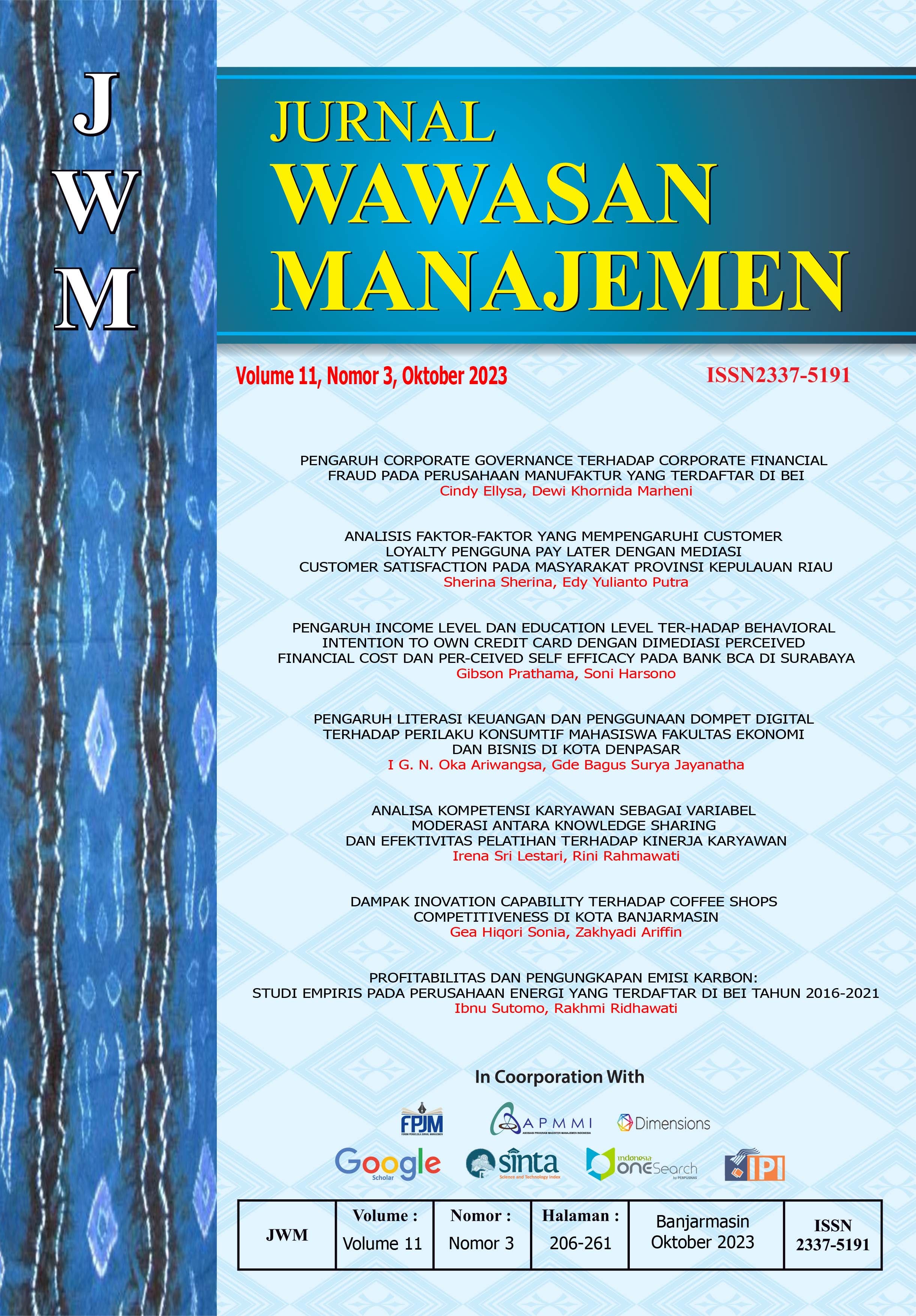
PENGARUH INCOME LEVEL DAN EDUCATION LEVEL TER-HADAP BEHAVIORAL INTENTION TO OWN CREDIT CARD DENGAN DIMEDIASI PERCEIVED FINANCIAL COST DAN PER-CEIVED SELF EFFICACY PADA BANK BCA DI SURABAYA
DOI:
https://doi.org/10.20527/jwmthemanagementinsightjournal.v11i3.248Keywords:
credit card, income level, education level, perceived financial cost, perceived financial coastAbstract
Credit cards are becoming a trend among the people of Surabaya to have them with vari-ous consequences that must be accepted. Even its use has increased post-covid-19. Of course, individuals who had it had to consider their income and qualified knowledge regarding credit cards. This study seeked to reveal the role of income level and education level on behavioral intention to own a credit card of BCA in Surabaya mediated by per-ceived financial cost and perceived self-efficacy using a quantitative method using Struc-tural Equation Modeling (SEM) with a total sample of 190 respondents from customers who own credit cards of BCA Bank in Surabaya. The results showed that income level and education level had an effect on perceived financial cost. Income level, education level, perceived financial cost, and perceived self-efficacy had an effect on behavioral intention to own. Income level and education level had an effect on behavioral intention to own through perceived financial cost, and income level and education level influenced behavioral intention to own through perceived self-efficacy. Suggestions for research need to broaden the scope was not only in Surabaya and the Bank needed to pay attention to income levels and customers' understanding of BCA credit cards.
Downloads
References
Bungin, Burhan. (2016). Metode penelitian kuantitatif. Jakarta: Rajawali Press.
Ferdinand, A. (2011). Metode Penelitian Manajemen (5th ed.). Semarang: Badan Penerbit Universitas Diponegoro.
Ghozali, I. (2012). Aplikasi SEM PLS (4th ed.). Sema¬¬rang: Badan Penerbit Universitas Diponegoro.
Khadijah. Prospek Pertumbuhan Kartu Kredit Mulus Setelah Pelonggaran PPKM. Bisnis.com, 17 Oktober 2021.
Monavia. Jumlah Kartu Kredit yang Beredar Turun Selama Pandemi Covid-19. Databoks, 29 Mei 2021.
Nguyen & John.(2018). Consumer intention and credit card adoption in Vietnam. Asia Pacific Journal of Marketing and Logistics Vol. 30 No. 4, 2018 pp. 779-796.
Potrich., Kelmara & Guilherme.(2017). How well do women do when it comes to financial literacy? proposition of an indicator and analysis of gender differences. Journal of Behavioral and Experimental Finance.
Sugiyono. (2017). Metode Penelitian Kuantitatif, Kualitatif dan R&D. Bandung: CV Alfabeta.
Tam, J. L. M. (2012). The Moderating role of perceived risk in loyalty intentions: An investigation in a service context. Marketing Intelligence and Planning, 30(1), 33– 52.
Wang, Jay, Michelle, Casey & Zhiyuan. (2018). Income, occupation and education: are they related to smoking behaviors in china?. PLOS ONE | https://doi.org/10.1371/journal.pone.0192571 February 8, 2018.
Warsame & Yousif. (2020). Determinants of customers’ attitude towards credit card usage in kenya. PJAEE, 17 (8).
Downloads
Published
Issue
Section
License
Copyright (c) 2023 JWM (JURNAL WAWASAN MANAJEMEN)

This work is licensed under a Creative Commons Attribution 4.0 International License.