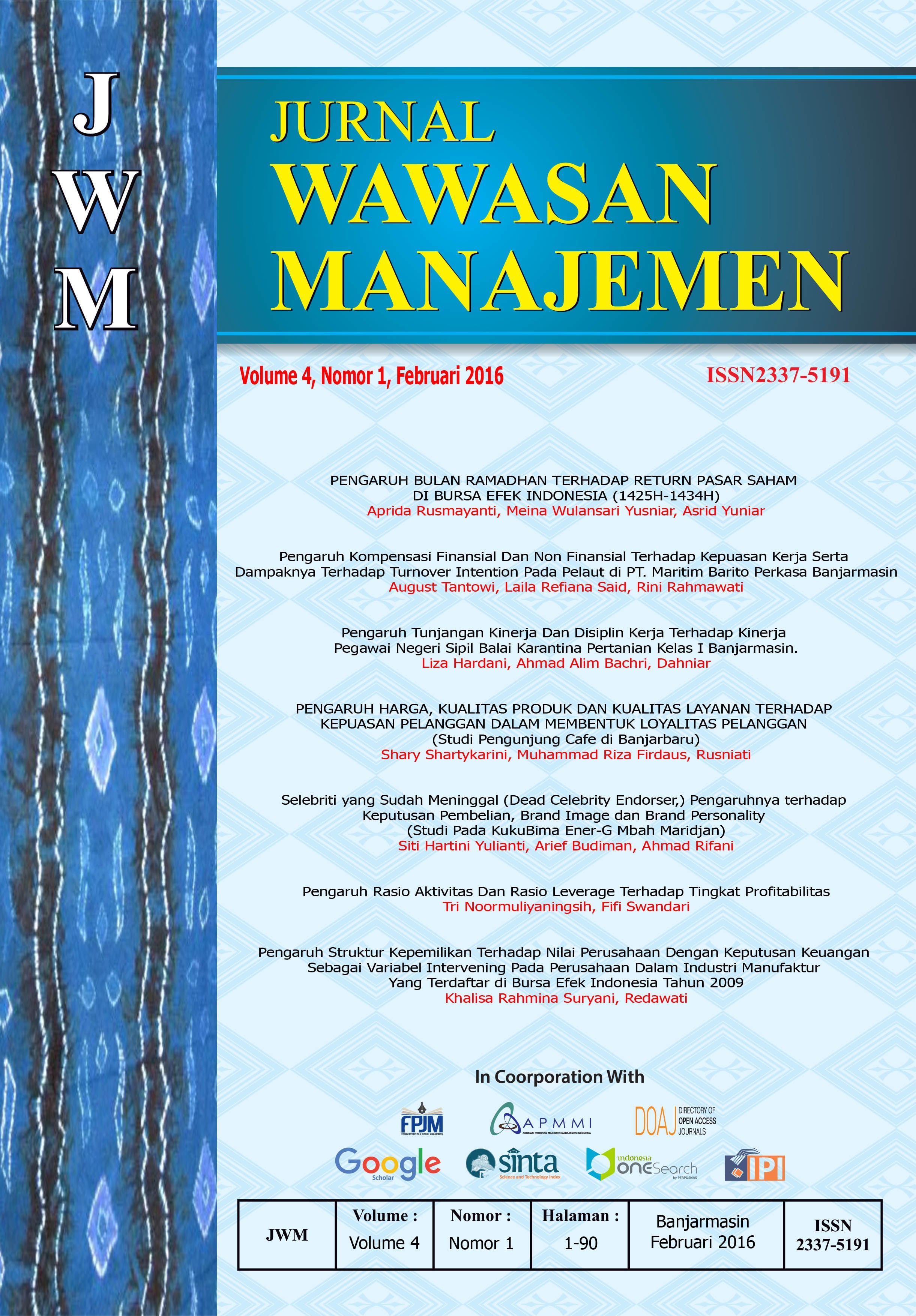
PENGARUH BULAN RAMADHAN TERHADAP RETURN PASAR SAHAM DI BURSA EFEK INDONESIA (1425H-1434H)
DOI:
https://doi.org/10.20527/jwmthemanagementinsightjournal.v4i1.132Kata Kunci:
Return of stock market, RamadhanAbstrak
The phenomenon of monthly effect is when the desire of financiers on the liquidity of stock changes from month to month in a year. This monthly effect of course is contrary to the concept of efficient markets, but it gives confidence to investors that there is still a gap to benefit by using information of price and sales volume in past. Ramadhan effect is monthly effect, it has been investigated several time in Islamic countries and it was found that there was a difference in market return during Ramadhan month rather than during any other months.
The purpose of this study was to describe the effect of Ramadhan on the stock market return in the Indonesia Stock Exchange (IDX). Ramadhan effect, is a seasonal anomaly in the financial markets, when stock returns during Ramadhan is different from the other. The unit of analysis used in this study is a JSX composite of 1425H-1434H (February
21, 2004 -3 November 2013). The statistical method used to test the hypothesis is nonparametric test (sign test), because the data are not normally distributed. The results showed that there was no influence of Ramadhan on the stock market return in the Indonesia Stock Exchange.
The cause of the lack of differences in returns among others due to the stability of the value of JSX Composite which is basic calculation of returns, but it also may be due to cultural differences and different conditions during the month of Ramadhan between Indonesia and other countries. Investor behavior changes that occur in other countries during Ramadhan does not occur in Indonesia due to the investors’s composition in Indonesia is still dominated by foreign and institutional investors.
The results of this study indicate that the capital market in Indonesia efficient in weak form, because the pattern of stock price movement is random or unpredictable
Unduhan
Referensi
Ahsan, A. F. M. Mainul & Ahasan H Sarkar, 2013, Does January Effect Exist in Bangladesh?,
International Journal of Business and Management, Vol. 8, No. 7; 2013
Akrami, Hamed, Mansour Garkaz & Aliza Mehrazin, 2012, ‘ The effect of Ramadhan month on stocks abnormal return of the companies accepted in Tehran stock exchange’, Economics and Finance Review, Vol. 2(5), pp. 45 – 51.
Al Al-Hajieh, Heitham, Keith Redhead and Timothy Rodgers, 2009, ’Investor Sentiment And Islamic Calendar Anomaly Effects: A Case Study Of The Impact Of Ramadan In Jordan’, Tesis
Al-Ississ, Mohamad, 2010, ‘The Impact Of Religious Experience On Financial Markets’,
Tesis.
Astuti, dina & Herman Legowo, 2009, ’Testing of January Effect Stock Exchange in
Jakarta (LQ 45 company case studies on the JSE),
Azimi, Javad, Mahmoud M Adin, Hossein Torkamanzadeh & Mohammad B Farahdoust,
, ’The effect of Muharram and Safar Months on Stock Return in Listed Firms on Tehran Stock Exchange (TSE)’, Interdisciplinary Journal Of Contemporary Research In Business, Vol 4, No 7
Bialkowski, Ahmad Etebari, and Tomasz Piotr Wisniewski, 2010, ’Piety and Profits: Stock
Market Anomaly during the Muslim Holy Month’, Tesis.
Darwis, 2009,’ Pengaruh Volume Perdagangan Terhadap Return Saham LQ-45 Selama
Bulan Ramadhan di BEI’, Jurnal STIE MDP
Dharani, M & N Vijayakumar, 2010, ’Impact Of Ramzan Fasting Effect On Return And
Volatility Of The S&P Cnx Nifty Shariah Index In India’, Tesis
Fakhruddin, M & M. Sopian Hadianto. 2001. Perangkat & Model Analisis Investasi di
Pasar Modal, PT. Elek Media Komputindo, Jakarta
Fama, Eugene F., “Efficient Capital Markets : A Review of Theory and empirical Work”
Journal of finance, Vol. 25, (May,1970), 383-417
Ferdinand, Prof Dr Agusty, 2006, Metode Penelitian Manajemen, Badan Penerbit Univer- sitas Diponegoro, Semarang.
Gumanti, Tatang Ary dan Elok Sri Utami., 2002, ‘Bentuk Pasar Efisien dan Pengujiannya’,
Jurnal Akuntansi & Keuangan, Vol. 4, No.1, p54-66
Hanafi, Mamduh M, 2012, Manajemen Keuangan, BPFE-Yogyakarta, Yogyakarta. Hartono, Jogiyanto, 2010, Teori portofolio dan analisis investasi. BPFE-yogyakarta,
Yogyakarta.
Hartono, Jogiyanto, 2013, Metodologi Penelitian Bisnis, BPFE-Yogyakarta, Yogyakarta. Husnan, Suad & Pudjiastuti, 1998, Dasar-Dasar Teori Portofolio dan Analisis Sekuritas,
UPP AMP YKN, Yogyakarta.
Iqbal, Muhammad Shahid ,Rehana Kouser & Muhammad Azeem, 2013, ‘Conventional And
Islamic Anomalies In Karachi Stock Exchange’, Sci.Int.(Lahore),25(4),999-1007
Mitchell, M C, Muhamad IM Rafi, Sean Severe & Jeffrey A. Kappen, 2014, ‘Conventional vs. Islamic Finance: The Impact of Ramadan Upon Sharia-Compliant Markets’, Organizations And Markets In Emerging Economies, Vol. 5, No. 1(9)
Mustafa, Khalid, 2011, The Islamic Calendar Effect On Karachi Stock Market, Presented at the 8th International Business Research Conference, on March 27-28, 2008 Crow- ne Plaza Hotel Dubai, UAE.
Pujiharjanto, Ambar, 2010, ‘Efek Kalender Bulanan Di Bursa Efek Indonesia: Bukti Em- piris Dan Implikasi, Buletin Ekonomi , Vol.8, No. 3, Desember 2010 hal 170-268 2
Prasetyo, Hari, 2006, ‘analisis pengaruh hari perdagangan Terhadap return, abnormal return, Dan volatilitas return saham (studi pada lq 45 periode januari – desember
’, Tesis.
PT. Kustodian Sentral Efek Indonesia. 2003. Press Realease Akhir Tahun 2003. PT. KSEI.
Jakarta
PT. Kustodian Sentral Efek Indonesia. 2012. Press Realease Akhir Tahun 2012. PT. KSEI.
Jakarta
Ramezani, Aliakbar Abbasali Pouraghajan, & Hossein Mardani, 2013, ‘Studying Impact of Ramadan on Stock Exchange Index: Case of Iran’, World Of Sciences Journal, Vol
, Issue 12, hal 46-54.
Santoso, Singgih. 2014.Statistik Nonparametrik. PT Elex Media Komputindo, Jakarta
Shah, s. M. Atiq Ur Rehman & Syed Nisar Ahmed, 2014, ‘ The Ramadan Effect on Stock
Market’, European Academic Research, Vol. I, Issue 11/ February 2014
Sharpe, W.F., Alexander, G.J, and Bailey, J.V., 1995, Investments, Sixth Edition, Prentice
Hall, New Jersey.
Ziemba, W.T., 2012, Calendar Anomalies and Arbitrage, World Scientific, Canada. http://www.financeroll.co.id diakses tanggal 25 april 2014 17.00 WITA http://www,economy.okezone.com tanggal 20 Agustus 2014 18.00 WITA
http ://www.idx.co.id diakses tanggal 7 April 2014 18.24 WITA http://www.islamicfinder.com diakses tanggal 25 april 2014 18.33 WITA http://www.kontan.co.id diakses tanggal 8 Juni 2014 19.19 WITA
http ://www.newstateman.com diakses tanggal 25 april 2014 20.10 WITA http ://www.thegulfonline.com diakses tanggal 25 april 2014 20.20 WITA http://www.yahoofinance.com diakses tanggal 2 Februari 2014 20.00 WITA
Unduhan
Diterbitkan
Terbitan
Bagian
Lisensi
Hak Cipta (c) 2022 JWM (JURNAL WAWASAN MANAJEMEN)

Artikel ini berlisensi Creative Commons Attribution 4.0 International License.