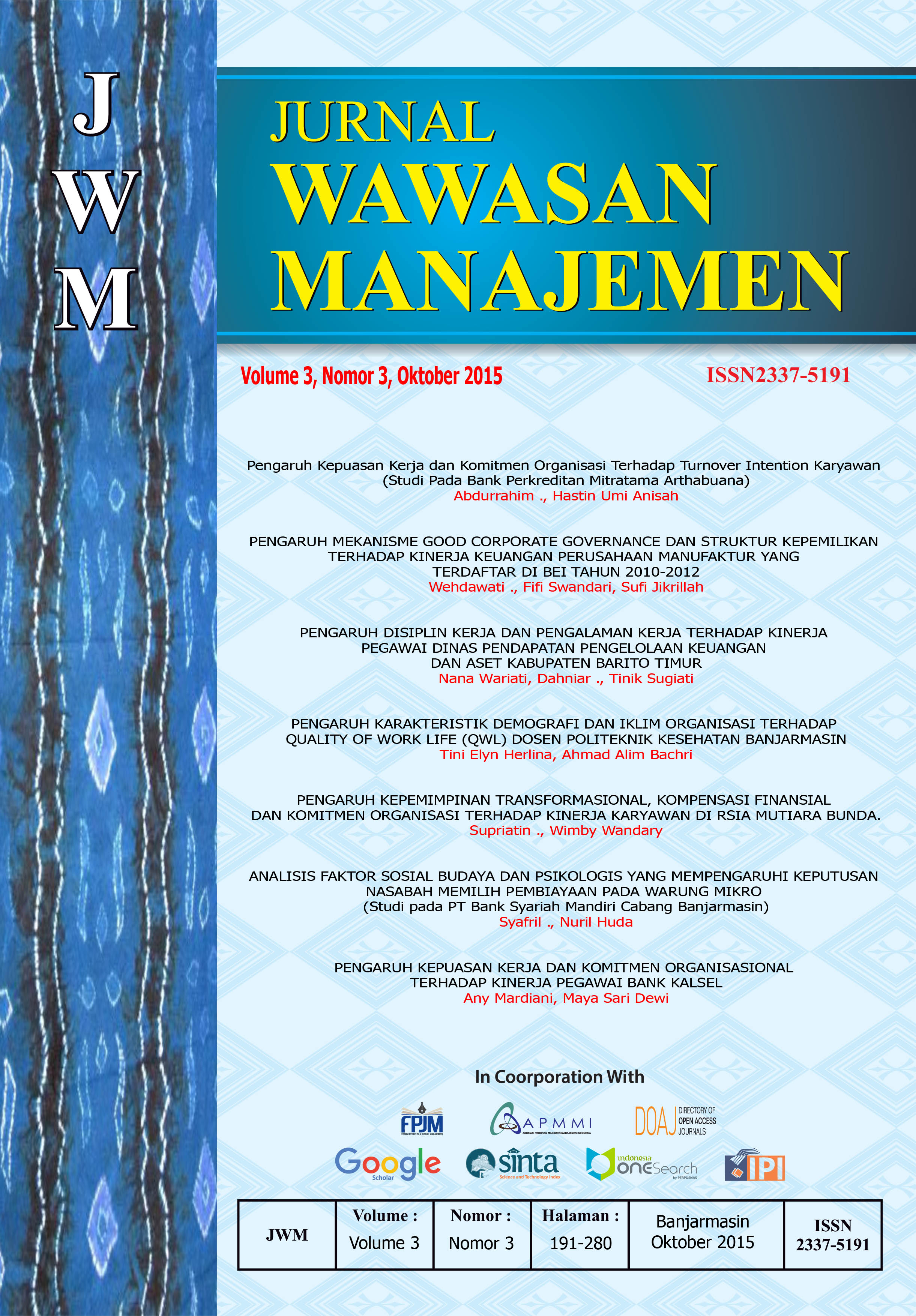
PENGARUH KARAKTERISTIK DEMOGRAFI DAN IKLIM ORGANISASI TERHADAP QUALITY OF WORK LIFE (QWL) DOSEN POLITEKNIK KESEHATAN BANJARMASIN
DOI:
https://doi.org/10.20527/jwmthemanagementinsightjournal.v3i3.142Kata Kunci:
Demographic characteristics, Organizational Climate, Quality of Work Life (QWL), Multiple Linear Regression Analysis, LecturerAbstrak
This study aims to identify and analyze the influence of demographic characteristics such as: Age, Gender, Work Period, marital status, Status Employment, Income, Number of dependents and education level as well as Organizational Climate either simultaneously or partially on the Quality of Work Life lecturer Polytechnic Health Banjarmasin.
The research method using a questionnaire with non-probability technique and accidental sampling obtained a sample of 69 lecturers from the Polytechnic Banjarmasin health of the population of 102 people. Measurements made with Likert scale variables and multiple linear regression analysis using software Statistical Package for the Social Science (SPSS) version 17.
The research concludes that there is a significant effect simultaneously on two independent variables: demographic characteristics and organizational climate on the dependent variable: Quality of Work Life, while only partially Organizational Climate variables which indicate a significant influence on the Quality of Work Life Lecturer Polytechnic Banjarmasin
Unduhan
Referensi
Aktami, B. 2011. Kontribusi Kepuasan Kerja dan Iklim Kerja terhadap Komitmen Kerja.
Jakarta: Universitas Gunadharma.
Almalki, M., Gerry, F., & Michele, C. 2012.QWL among primary Health Care Nurses in The Jazan Region Saudi Arabia: a cross-sectional study.Retrieved 2012, from Human Resources for Health: http://www.human-resources-health.com
Al-Quttop, M.-A. Y., & Harrim, H. 2011. Quality of Work Life Human Well-Being Linkage: Integrated Conceptual Framework. International Journal of Business and Management vol. 6, No. 8 .
Amin, Z. 2013. QWL in Indonesian public service organizations: The role of Career development and personal factors, International Journal of Applied Psychology 2013,
(3): 38-44
Arifin, N. 2012. Analisis Kualitas Kehidupan Kerja, Kinerja dan Kepuasan Kerja pada CV.
Duta Senenan Jepara. Jurnal Economia Vol. 8, No. 1 , 11-21.
Asgari, M. H., & Dadashi, M. A. 2011. Determining the Relationship Between Quality of Work Life (QWL) and organizational Commitment of Melli Banks Staff West Domain Mazandaran in 2009-2010. Australian Journal of Basic and Applied Science
(8) , 682-687.
Asgari, M. H., Nojbae, S., & Ommolbanin, R. 2012. The Relationship between Quality of Work Life and Performance of Tonekabon Guidance Schools Teachers. Journal of Basic and Applied Scientific Research, vol 2. No. 3 , 2569-2575.
Bolhari, A., Rezaeean, A., Bolhari, J., & Zare, F. 2012. The Impact of Occupational Stress on Quality of Work Life among the Staff of e- Workspace. World Academy of Science, Engineering and Technology no.67,314-318.
Bolhari,A., Rezaeean,A., Bolhari, J., Bairamzadeh, S., & Soltan,A.A. 2011. The Relationship between Quality of Work Life and Demographic Characteristics of Information Technology Staffs. International Confrerence on Computer Communication and Management Vol 5. Singapore: IACSIT.
Botutihe, S. 2010. Sumbangan Keadilan Organisasi dan iklim Organisasi. Inovasi, vol.7 no.4 Desember , 240-253. 2012. Buku Pedoman Sertifikasi Untuk Dosen Terintegrasi (Serdos). Buku 1.
Naskah Akademik. Direktur Jenderal Pendidikan Tinggi Kementerian Pendidikan dan Kebudayaan. http://www.dikti.go.id/files/Diktendik/Dosen/Buku_Serdos/ pedoman serdos.2012.pdf .[Tanggal akses: 11 Maret 2013]
Cascio, W. 2006. Managing Human Resources:Productivity,Quality of Work Life, Profits.7th.
New York: McGraw-Hill Irwin.
Charoenphol, S. 2000. Organization climate affecting quality of work life of the personel in the bank of agriculture and agricultural co-operatives, Khon Kaen province.
Dargahi, H., & Seragi, J. 2007. An Approach Model for Employees’ Improving Quality of Work. Iranian Journal of Public Health vol. 36, No. 4 , 81-86. 2010. Dasar- Dasar Demografi. Universitas Indonesia. Jakarta: Salemba empat. Dasgupta, M.
Emotional Intelligence emerging as a significant tool for Female Information Technology professionals in managing role conflict and enhancing. Asian Journal of Management Research , 558-565.
Davis, K., & Newstrom, J. W. 1985. Perilaku dalam Organisasi jilid 1 edisi ke-7. Erlangga. Dessler, G. 1984. Manajemen Personalia Teori dan Konsep Modern edisi 3. Jakarta.
Erlangga.
El Itany, B. Mohamad. 2010. Effect of Learning Organization on Organization Climates.
Labanese American University.
Emadzadeh, M. K., Khorasani, M., & Nematizadeh, F. 2012. Assessing The Quality of Work Life of Primary School Teachers in Isfahan City. Interdiciplinary Journal Of Contemporary Research in Business Vol 3, No.9 , 438-448.
Ghozali, I. 2007. Aplikasi Analisis Multivariate dengan Program SPSS Cetakan 4.
Semarang. Badan Penerbit Universitas Diponegoro.
Gibson, J. L., Ivancevich, J. M., & Donelly, J. H. 1996. Organisasi Perilaku- struktur- proses jilid 1,ed.8. Jakarta: Binarupa Aksara.
Harrington, S. J. 2006. Organizational Culture and Telecommuters’ Quality of Work Life.
Communications of the IIMA vol 6,issue 3 .
Holbche, L. 2005. The High Performance Organization: Creating Dynamic
Sustainable Success. Oxford: Elsevier Butterworth Heinemenn.
Husnawati, A. 2006. Analisis Pengaruh Kualitas Kehidupan Kerja dan kinerja melalui komitmen dan kepuasan sebagai intervening. Tesis. Universitas Diponegoro. Semarang
Idrus, M. 2006. Implikasi Iklim Organisasi Terhadap Kepuasan Kerja dan Kualitas. Jurnal
Psikologi Universitas Diponegoro vol.3, no.1 .
Islam, M. Z., & Siengthai, S. 2009. Quality of work life and organizational performance: Empirical evidence from Dhaka Export Processing Zone. ILO Conference on “Regulating for Decent Work”. Geneva.
Ivancevich, J. M., Konopaske, R., & Matteson, M. T. 2007. Perilaku dan Manajemen
Organisasi Jilid I. Jakarta: Erlangga.
Jannatin, M. K., & Hadi, C. 2012. Pengaruh Kualitas Kehidupan Kerja terhadap Produktivitas
Karyawan Produksi. Jurnal Psikologi Industri dan Organissasi Vol.1, No. 2 .
, 2013. Kamus Besar Bahasa Indonesia. http: //www.perpusonline.com/ kamus- besar-indonesia-versi-pdf.html. [Tanggal Akses: 10 April 2013]
Kandasamy, I., & Sreekumar, A. 2009. WRKLFQUAL: a tool for measuring Quality of Work Life. Research and Practice in Human Resources Management vol 17(1) ,
-70.
Kast, F. E., & Rosenzweig, J. E. 2002. Organisasi dan Manajemen 2,edisi ke-4. Jakarta: Bumi Aksara.
Kaur, A. 2011. Mangalam Institute of Management. Retrieved november 17, 2011, from
Mangalam Institute of Management.
Kolb, D., & I.M.Rubin. 1984. Organization Psychological an Experiental Approach to
Organizational Behavior. New Jersey: Prentice Hall Inc.
Luthans, F. 2006. Perilaku Organisasi edisi 10. Yogyakarta: Penerbit Andi.
Mariyappan M.S.R.,& Sharmilla A. 2013 : Relationship between QWL and Demographic Characteristics of management faculties of self-finacing Institution in Tamil Nadu, Advance in management, Vol 6 (9) Sept. (2013)
Mellita, D. 2007. Gender Difference in Quality of Work Life and Organization Commitment
Among Lecturer in Private University: a case of Palembang Unika Atmajaya Press .
Moeheriono. 2012. Pengukuran Kinerja Berbasis Kompetensi. Bogor: Penerbit Ghalia
Indonesia.
Mondy, R. W. 1980. Management, Concept and Practice. Boston: Allyn and Bacon Inc.
Nisfiannoor, M. 2009. Pendekatan Statistika Modern untuk Ilmu Sosial. Jakarta: Salemba Humanika.
Normala, D. 2010. Investigating the Relationship between Quality of Work Life and commitmen among emloyees in Malaysian. International Journal and Business Management vol 5 no 10 .
-----------. 2013. Profil Poltekkes Banjarmasin. http://poltekkes-banjarmasin.ac.id/index.
php? option=com_content&view=article&id=83&I temid=2. [akses 15 Juli 2013]
Pugalendhi, S., M, U., & Nakkeeran, S. K. 2010. QWL: Perception of College Teachers.
Munich Personal RePEc Archive .
Punto, S., & Krisna, B. 2011. The Happiness and Quality of Working Life of Employees in an Organization in The Town Municipality-LomSak, Phetchabun Province,Thailand.
rd National Graduate Research Conference, (pp. 484-461). india.
Rahardjanto, T. H. 2003. Modul 13: Iklim Komunikasi Organisasi. Jakarta: Universitas
Mercubuana.
Reddy.M, L., & Reddy.P, M. 2010. Quality of Work Life of Employees: emerging
dimensions. Asian Journal of Management Research,1.
Robbins, S. P. 2003. Perilaku Organisasi Buku 1. Jakarta: PT. Indeks Kelompok Gramedia. Rose, R. C., Beh, L., Uli, J., & Idris, K. 2006. QWL: Implications of Career Dimensions.
Journal of Sciences 2(2) , 61-67.
Salvatore, D. 1982. Schaum’s Outline of Theory and Problems of Statistics and Econometrics.
McGraw-Hill Book Company.
Schoepke, J., Hoonakker, P., & Carayon, P. 2004. Quality of Work Life among Women and Men in The Information Technology Workforce. Human Factor and Ergonomics Society 48th Annual Meeting, (pp. 1576-1580).
Siagian, S. P. 2012. Manajemen Sumber Daya Manusia Ed.1 cetakan 20. Jakarta: PT. Bumi
Aksara.
Sinha, C. 2012. Factors Affecting Quaity of Work Life: empirical evidance from Indian
Organizations. Australian Journal of Business and Management Research Vol.1
No.11 , 31-40.
Sirgy M.J, Efraty D, Siegel P, Lee DJ. 2001. A New Measure of Quality of work life based on need satisfaction and spillover theories. Social Indicators Rescource. 2001, vol.
(3): 241-307
Sivakumar, K. 2012. Organisational climate in Tamilnadu Cement Corporatio Ltd. Ariyalur
Disertasi. Tamilnadu
Sugiyono. 2010. Statistika Penelitian. Bandung: Alfabeta.
Sule, O. E. 2013. Managing Human Resources and Industrial Relation in Nigeria
International Journal of Business Administration vol.4, no.2 , 8-17.
Tabassum, A. 2012. Interrelations between Quality of Work Life Dimensions and Faculty Member job satisfaction in the privat universities of Bangladesh. European journal of business and Management vol 4. No. 2 .
Tabassum, A., Rahman, T., & Jahan, K. 2011. QWL among Male and Female Employees of Private Commercial Banks in Bangladesh. International Journal of Economics and Management 5(1) , 266-282.
Timossi, L.d., Pedroso, B., de Francisco, A. C., & Pillati, L.A. 2008. Evaluation of Quality of Worklife: an Adaptation from TheWalton’s QWL Model. International Conference on Industrial Engineering and Operations Management. Brazil: ABEPRO
UI, T. P. 2010. Dasar-Dasar Demografi. Jakarta: Salemba empat.
Valizadeh, A., & Ghahremani, J. 2012. Organizational Culture and Telecommuters’ Quality of Work Life. European Journal of Experimental Biology 2(5), 1722-1727.
Van der Berg, Y. 2011. The Relationship between organizational Trust and Quality of Work
Life. University of South Africa.
Widhiarso, W.2010. Pengembangan Skala Psikologi: Lima kategori respons ataukah Empat kategoti Respon?. Yogyakarta:UGM
Widyastuti, U., & Purwana, D. 2012. Analisis Faktor-Faktor dalam Kualitas Kehidupan
Kerja di Fakultas Ekonomi Universitas Negeri Jakarta. Econosains Vol.X No.1 .
Wirawan. 2008. Budaya dan Iklim Organisasi Teori, Aplikasi dan Penelitian. Jakarta: Salemba empat.
Zulkarnain., Mahamood, Y., Omar, F. 2010. Implication of career development and
Demographic Factors on Quality of Work Life, Jurnal Psikologi, Vol.37, No.1, Juni
hal 23-33.
Unduhan
Diterbitkan
Terbitan
Bagian
Lisensi
Hak Cipta (c) 2022 JWM (JURNAL WAWASAN MANAJEMEN)

Artikel ini berlisensi Creative Commons Attribution 4.0 International License.