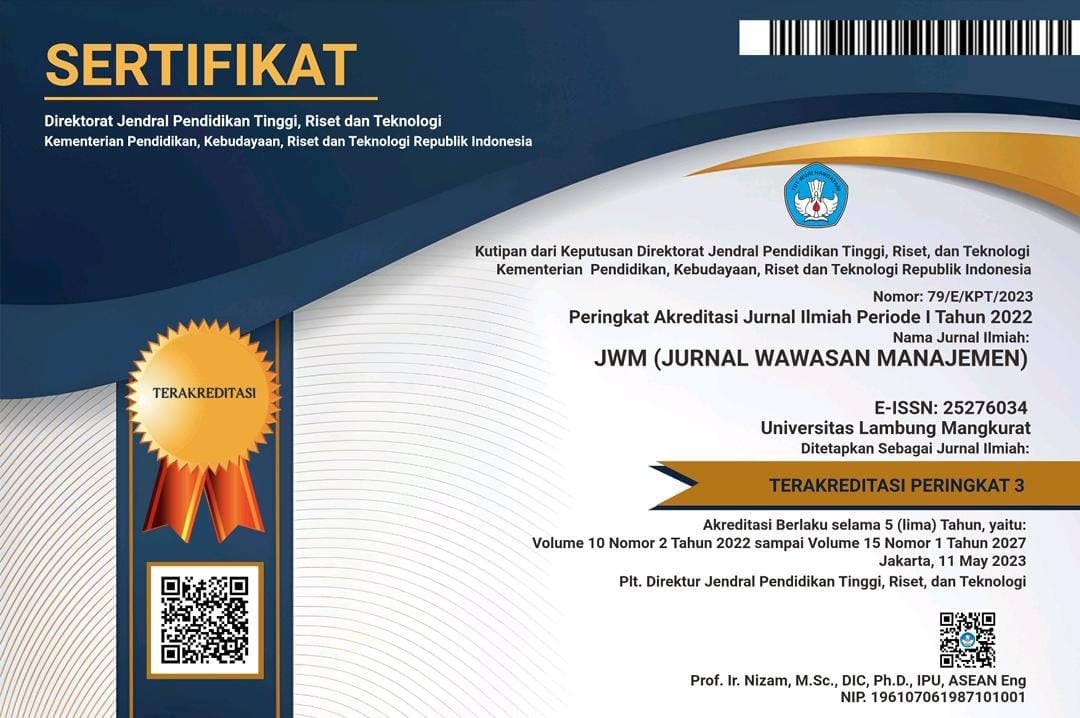
Dari Informasi ke Donasi: Bagaimana Konten di Media Sosial Mempengaruhi Niat Donasi di Platform Amal Online? Peranan Rasa Syukur Sebagai Moderasi
DOI:
https://doi.org/10.20527/jwm.v14i1.396Kata Kunci:
kemurahan hati, konten informasi, media sosial, niat donasi amal, rasa syukurAbstrak
Advances in digital technology have revolutionized the world of philanthropy, driving the rapid growth of online donations in Indonesia. This study aims to understand the influence of information content on social media on one's intention to donate through online fundraising platforms, while also examining the role of generosity as a mediating variable and gratitude as a moderating variable in this relationship. This study employs a quantitative approach, collecting data from 300 respondents via an online questionnaire using the T-Survey platform. The data are analyzed using the Structural Equation Modeling (SEM) method, aided by SmartPLS 4.1 software. The results showed that information content positively and significantly affects charity donation intention. In addition, information content also significantly affects generosity, which in turn impacts increasing donation intentions. Other findings show that gratitude positively and significantly strengthens the influence of information content on donation intentions. This study makes a theoretical contribution to the literature on digital donation behavior and offers practical implications for nonprofit organizations in designing effective communication strategies through social media.
Unduhan
Referensi
Albinsson, P. A., Perera, B. Y., Nafees, L., & Burman, B. (2019). Collaborative consumption usage in the US and India: An exploratory study. Journal of Marketing Theory and Practice, 27(4), 390–412. https://doi.org/10.1080/10696679.2019.1644956
Annur, C. M. (2024, March 14). Banyak orang Indonesia sering donasi online lebih dari 2,5% penghasilannya. Databoks.katadata.co.id. https://databoks.katadata.co.id/layanan-konsumen-kesehatan/statistik/c1801e145bd3b03/banyak-orang-indonesia-sering-donasi-online-lebih-dari-25-penghasilannya
Bekkers, R., & Wiepking, P. (2011). A literature review of empirical studies of philanthropy: Eight mechanisms that drive charitable giving. In Nonprofit and Voluntary Sector Quarterly, 40 (5), 924–973). https://doi.org/10.1177/0899764010380927
Bhati, A., & McDonnell, D. (2020). Success in an online giving day: The role of social media in fundraising. Nonprofit and Voluntary Sector Quarterly, 49(1), 74–92. https://doi.org/10.1177/0899764019868849
Bilgin, Y., & Kethüda, Ö. (2022). Charity social media marketing and its influence on charity brand image, brand trust, and donation intention. Voluntas, 33(5), 1091–1102. https://doi.org/10.1007/s11266-021-00426-7
Bock, D. E., Eastman, J. K., & Eastman, K. L. (2018). Encouraging consumer charitable behavior: The impact of charitable motivations, gratitude, and materialism. Journal of Business Ethics, 150(4), 1213–1228. https://doi.org/10.1007/s10551-016-3203-x
Buzeta, C., De Pelsmacker, P., & Dens, N. (2020). Motivations to use different social media types and their impact on consumers’ online brand-related activities (COBRAs). Journal of Interactive Marketing, 52, 79–98. https://doi.org/10.1016/j.intmar.2020.04.004
Card, N. A. (2019). Meta-analyses of the reliabilities of four measures of gratitude. Journal of Positive Psychology, 14(5), 576–586. https://doi.org/10.1080/17439760.2018.1497690
Chawla, Y., & Chodak, G. (2021). Social media marketing for businesses: Organic promotions of web-links on Facebook. Journal of Business Research, 135, 49–65. https://doi.org/10.1016/j.jbusres.2021.06.020
Chen, H., Li, W., Lyu, T., & Zheng, X. (2021). Understanding people’s participation in online charities: a dual-process approach of trust and empathic concern. Industrial Management and Data Systems, 121(7), 1642–1663. https://doi.org/10.1108/IMDS-09-2020-0513
Dwyer, R. J., Brady, W. J., Anderson, C., & Dunn, E. W. (2023). Are people generous when the financial stakes are high? Psychological Science, 34(9), 999–1006. https://doi.org/10.1177/09567976231184887
Elvira-Lorilla, T., Garcia-Rodriguez, I., Romero-Merino, M. E., & Santamaria-Mariscal, M. (2024). The role of social media in nonprofit organizations’ fundraising. Nonprofit and Voluntary Sector Quarterly. https://doi.org/10.1177/08997640231213286
Emmons, R. A., & McCullough, M. E. (2003). Counting blessings versus burdens: An experimental investigation of gratitude and subjective well-being in daily life. Journal of Personality and Social Psychology, 84(2), 377–389. https://doi.org/10.1037/0022-3514.84.2.377
Feng, Y., Du, L., & Ling, Q. (2017). How social media strategies of nonprofit organizations affect consumer donation intention and word-of-mouth. Social Behavior and Personality, 45(11), 1775–1786. https://doi.org/10.2224/sbp.4412
Gorczyca, M., & Hartman, R. L. (2017). The new face of philanthropy: The role of intrinsic motivation in millennials’ attitudes and intent to donate to charitable organizations. Journal of Nonprofit and Public Sector Marketing, 29(4), 415–433. https://doi.org/10.1080/10495142.2017.1326349
Guttena, R. K., Wu, C. H. J., & Atmaja, F. T. (2024). The influence of brand-related social media content on customer extra-role behavior: A moderated moderation model. Journal of Product and Brand Management, 33(2), 220–233. https://doi.org/10.1108/JPBM-05-2022-3999
Hair, J. F., Hult, G. T. M., Ringle, C. M., Sarstedt, M., Danks, N. P., & Ray, S. (2021). Partial Least Squares Structural Equation Modeling (PLS-SEM) Using R. Springer International Publishing. https://doi.org/10.1007/978-3-030-80519-7
Hasya, R. (2023, February 9). Partisipasi gen z Indonesia dalam berdonasi secara daring meningkat dalam 3 tahun terakhir. Goodstats.id. https://goodstats.id/article/partisipasi-gen-z-indonesia-dalam-berdonasi-secara-daring-meningkat-dalam-3-tahun-terakhir-7RnkB
Hellwig, K., Morhart, F., Girardin, F., & Hauser, M. (2015). Exploring different types of sharing: A proposed segmentation of the market for “sharing” businesses. Psychology and Marketing, 32(9), 891–906. https://doi.org/10.1002/mar.20825
Kim, M., & Kim, J. (2024). From empathetic hearts to digital hands: A study of compassion and donation behavior in social media advertising. Journal of Retailing and Consumer Services, 79, 103855. https://doi.org/10.1016/J.JRETCONSER.2024.103855
Li, B., Hou, F., Guan, Z., & Chong, A. Y. L. (2023). The use of social media for a better world: roles of social experience, empathy and personal impulsiveness in charitable crowdfunding. Information Technology and People, 36(6), 2587–2610. https://doi.org/10.1108/ITP-04-2021-0264
Liu, C. J., & Hao, F. (2017). Reciprocity belief and gratitude as moderators of the association between social status and charitable giving. Personality and Individual Differences, 111, 46–50. https://doi.org/10.1016/j.paid.2017.02.003
Liu, L., Suh, A., & Wagner, C. (2018). Empathy or perceived credibility? An empirical study on individual donation behavior in charitable crowdfunding. Internet Research, 28(3), 623–651. https://doi.org/10.1108/IntR-06-2017-0240
Lovejoy, K., & Saxton, G. D. (2012). Information, community, and action: How nonprofit organizations use social media. Journal of Computer-Mediated Communication, 17(3), 337–353. https://doi.org/10.1111/j.1083-6101.2012.01576.x
Lwin, M., & Phau, I. (2014). An exploratory study of existential guilt appeals in charitable advertisements. Journal of Marketing Management, 30(13–14), 1467–1485. https://doi.org/10.1080/0267257X.2014.939215
Madli, F., Sondoh, S., Totu, A., Ramayah, T., Janin, Y., Syed Annuar, S. N., & Cham, T. H. (2024). Modelling organ donation information adoption among Malaysian youth using the information adoption model (IAM). International Journal of Pharmaceutical and Healthcare Marketing, 18(2), 252–275. https://doi.org/10.1108/IJPHM-08-2022-0077
McCullough, M. E., Emmons, R. A., Kilpatrick, S. D., & Larson, D. B. (2001). Is gratitude a moral affect? Psychological Bulletin, 127(2), 249–266. https://doi.org/10.1037/0033-2909.127.2.249
Mendini, M., Peter, P. C., & Maione, S. (2022). The potential positive effects of time spent on Instagram on consumers’ gratitude, altruism, and willingness to donate. Journal of Business Research, 143, 16–26. https://doi.org/10.1016/j.jbusres.2022.01.046
Muhamad, N. (2023, November 16). 10 negara paling dermawan di dunia 2023, Indonesia juara. Databoks.katadata.co.id. https://databoks.katadata.co.id/demografi/statistik/5530a2bc04aefb0/10-negara-paling-dermawan-di-dunia-2023-indonesia-juara
Paramita, W., Septianto, F., & Tjiptono, F. (2020). The distinct effects of gratitude and pride on donation choice and amount. Journal of Retailing and Consumer Services, 53. https://doi.org/10.1016/j.jretconser.2019.101972
Ramondt, S., Kerkhof, P., & Merz, E. M. (2022). Blood donation narratives on social media: A topic modeling study. Transfusion Medicine Reviews, 36(1), 58–65. https://doi.org/10.1016/j.tmrv.2021.10.001
Rimawati, Y., Isnalita, & Soewarno, N. (2024). Philanthropic organizations posted on social media: What important values make netizens react and donate? Journal of Nonprofit & Public Sector Marketing. https://doi.org/10.1080/10495142.2024.2417814
Saxton, G. D., & Wang, L. (2014). The social network effect: The determinants of giving through social media. Nonprofit and Voluntary Sector Quarterly, 43(5), 850–868. https://doi.org/10.1177/0899764013485159
Tam, K. P. (2022). Gratitude to nature: Presenting a theory of its conceptualization, measurement, and effects on pro-environmental behavior. Journal of Environmental Psychology, 79. https://doi.org/10.1016/j.jenvp.2021.101754
Wallace, E., Buil, I., & de Chernatony, L. (2017). When does “liking” a charity lead to donation behaviour?: Exploring conspicuous donation behaviour on social media platforms. European Journal of Marketing, 51(11–12), 2002–2029. https://doi.org/10.1108/EJM-03-2017-0210
Xiao, A., Huang, Y., Bortree, D. S., & Waters, R. D. (2022). Designing social media fundraising messages: An experimental approach to understanding how message concreteness and framing influence donation intentions. Nonprofit and Voluntary Sector Quarterly, 51(4), 832–856. https://doi.org/10.1177/08997640211022838
Xiao, W., Lin, X., Li, X., Xu, X., Guo, H., Sun, B., & Jiang, H. (2021). The influence of emotion and empathy on decisions to help others. SAGE Open, 11(2). https://doi.org/10.1177/21582440211014513
Yost-Dubrow, R., & Dunham, Y. (2018). Evidence for a relationship between trait gratitude and prosocial behaviour. Cognition and Emotion, 32(2), 397–403. https://doi.org/10.1080/02699931.2017.1289153
Unduhan
Diterbitkan
Terbitan
Bagian
Lisensi
Hak Cipta (c) 2026 JWM (JURNAL WAWASAN MANAJEMEN)

Artikel ini berlisensi Creative Commons Attribution 4.0 International License.